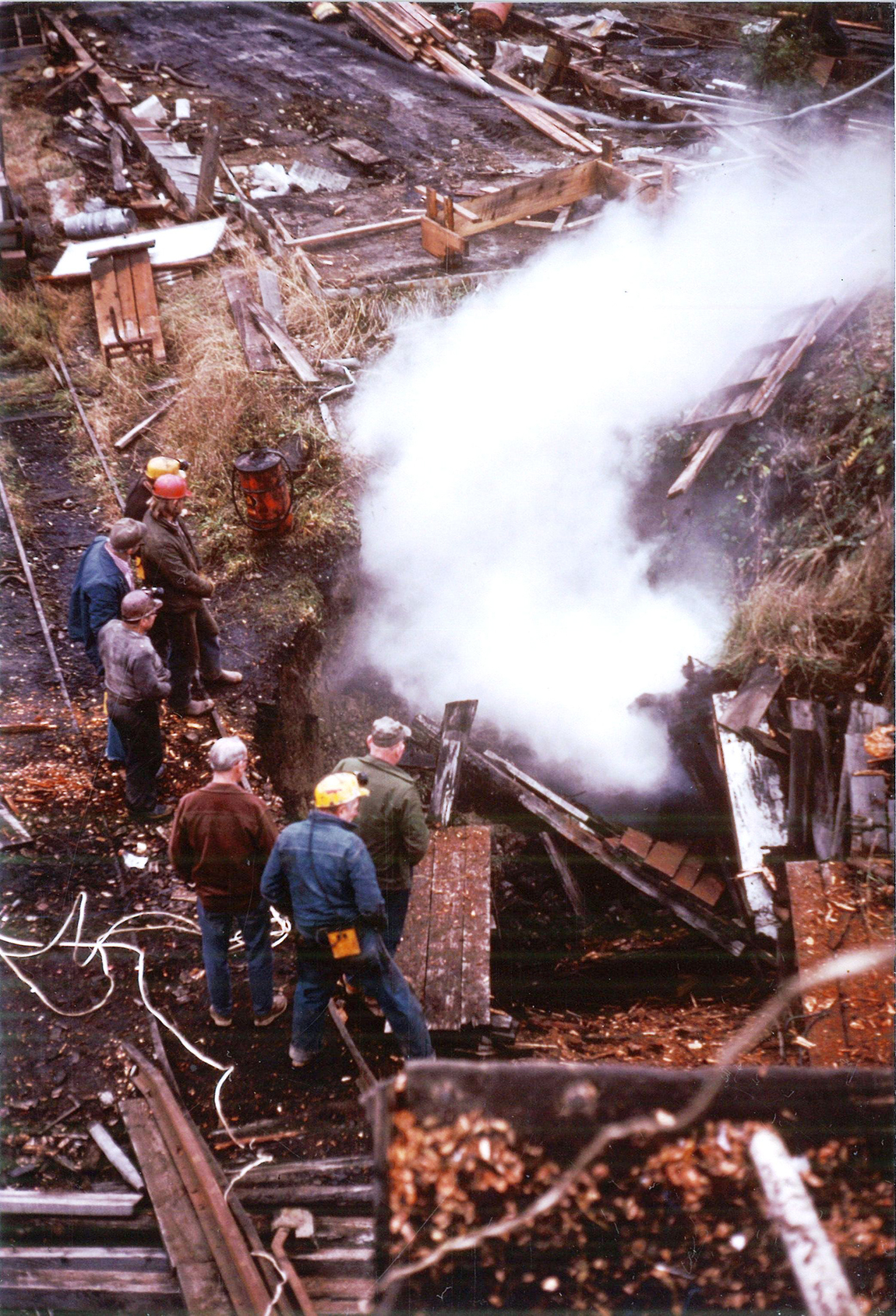
Just minutes after the portal opening to the Rogers #3 mine was sealed shut with a dynamite blast, a group of miners watched residual smoke rise from the last underground coal mine in Washington state. The time and date – December 17, 1975, at 2:30 pm – when Palmer Coking Coal Company’s Ravensdale operation closed was recorded for posterity. Fifty years ago this week, active and retired miners gathered to observe the solemn occasion. Pictured from bottom to top were John Costanich, John Streepy, Charles Anselmo, Tony Basselli, George Savicke, Bob Morris, and Bill McLoughry. Carl Falk, the company’s office manager, captured the moment.
Rogers No. 3 mine was located at the 262nd block of S.E. Kent-Kangley Road in Ravensdale. The mine was connected below ground to the first two portals, Rogers No. 1 and No. 2, where coal mining commenced in 1959 and 1960, respectively. Enoch Rogers, a bulldozer operator from Enumclaw, uncovered the vein of coal. Afterwards, both management and miners began calling it the Rogers seam.
Enoch’s father, Joseph Mattias Rogers, was a Welsh coal miner who immigrated to America in 1906, married a Welsh girl, Elizabeth Jones, and raised a family of 11 children, dying in 1954 after a 40-year mining career.
Their seventh child, Enoch James Rogers, was born in Cumberland in 1919 and began his mining career in Durham for Palmer. In 1987, Enoch told the story of a record set by him and his brother, Lew Rogers. For one 8-hour shift at the Durham Mine in 1939, Lew, who was 30 years old, and Enoch, age 20, drilled a round of 24 holes with steel augers and blasted the seam of coal with dynamite. They proceeded to load coal cars, each carrying 2.5 tons, pushed them out of the mine, dumped them, and returned, until 30 loads totaling 75 tons were tallied. The Rogers brothers’ production of 37.5 tons per miner that day far outstripped the average miner’s output of five tons.
Enoch Rogers married Helen (Shavic) Walczak in 1942, and their union produced five children: Arleen, Jo, Susan, Dick, and Mary, all of whom grew up in Enumclaw. Enoch left Palmer Coking Coal about 1967 but continued working as a heavy equipment operator. He finished his career with the State Game Department, retiring in 1981. Helen passed away in 1995, while Enoch died on March 17, 2001.
The Rogers coal seam was unique in Washington state coal history for its near-vertical dip. Coal seams are part of the sedimentary formation deposited millions of years ago in horizontal layers. Due to continental drift and plate tectonics, the Cascade Mountain range was formed. Its uplift caused the sedimentary layer to twist and bend.
The 6,000-foot-thick layer area around greater-Black Diamond was known as the Puget Group, which contains 18 interbedded coal seams. Between the Cedar River and Ravensdale, three coal seams were twisted upward, to an almost vertical pitch in the case of the Rogers, though not that steep in the nearby Landsburg and Danville veins. The Rogers seam is mostly the same McKay coal seam that made Black Diamond famous. Coal mining in Danville commenced in 1896. Danville was the name given to the area south of the Cedar River near the Summit-Landsburg Road. Early operations were small, and despite an extension of a Columbia & Puget Railroad branch line, all of them failed. It wasn’t until 1937, when Palmer Coking Coal assumed operations, that mining flourished, first on the Danville and Landsburg seams, and later on the Rogers.
The Rogers seam was 16 feet wide and consisted of coal, inter-bedded shale, and parting rock. The No. 3 mine reached depths of 750 feet below the ground surface. The mine was operated on four levels, separated by counters and cross-cut tunnels used for access, production, and circulation of fresh air throughout the mine. Mining was accomplished by drilling and blasting coal with dynamite, causing it to cave through vertical chutes, where it was machine-loaded onto five-ton coal cars. The cars were pulled by a hoist (imagine a giant fishing reel sporting a one-inch steel cable) out of the mine on rails, for initial processing. As a result of mining this near-vertical coal seam, a subsidence trench developed on the land surface above the mine workings.
During their 17 years of operation from 1959 to 1975, the Rogers No. 1, 2, and 3 mines extracted approximately 890,000 tons of raw coal, from which 493,634 tons were sold as clean coal.The operation typically supported a crew of 16 to 25 coal miners working two shifts. Surface facilities included a hoist, a machine shop, and a tipple with sorting screens and storage bunkers.
Raw coal from the Ravensdale mine was transported by dump trucks to a coal preparation facility in Black Diamond for cleaning and sizing. That plant was locally known as Mine No. 11, once the site of the nation’s deepest underground coal mine. Most of the clean coal from the Rogers coal mines was sold to large institutional users, including the University of Washington, the Rainier School in Buckley, the Shelton prison, and the Monroe Reformatory.
In the 1970s, many state institutions began converting their fuel source from coal to natural gas. In addition, strict mine safety laws failed to account for the unique characteristics of the mine’s vertically dipping coal seam, resulting in a rapid increase in mining costs. Declining coal markets, coupled with escalating production costs, led to the decision to close Rogers No. 3 mine. After 122 years, on December 17, 1975, underground coal mining came to an end in Washington.