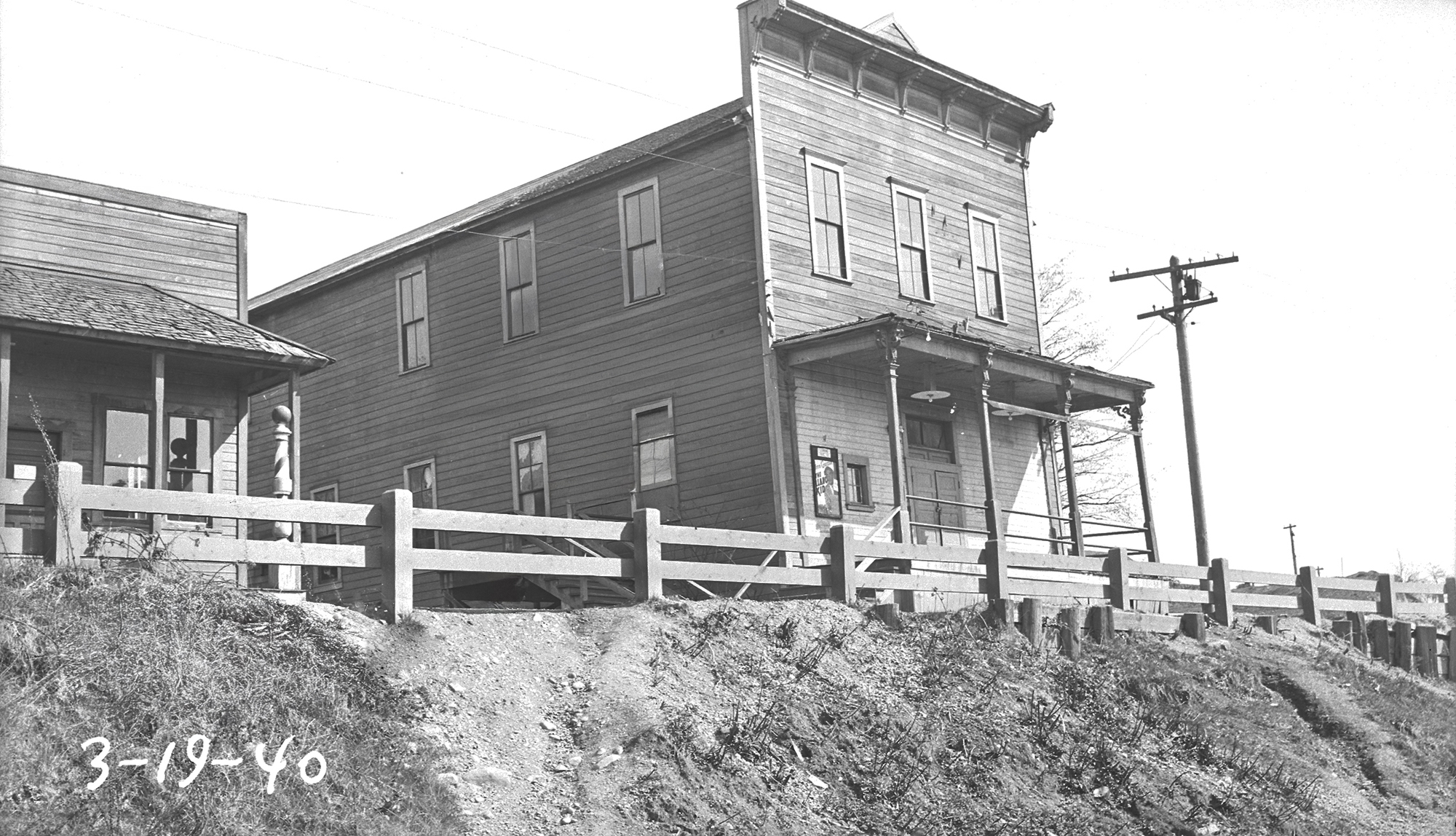
Last week’s column told the early history of the Lodge Hall, built by the Black Diamond Coal Mining Company after the town’s founding in 1885. The building was located on Main Street that paralleled Railroad Avenue. To the left of the hall stood the barber shop that doubled as a pool hall. Both were across the street from the General Store, which was slightly north of today’s Smokehouse & More. This March 19, 1940, photo of both buildings comes courtesy of the King County Assessor records, tax parcel 084400-0695, held at the Puget Sound Regional Archives in Eastgate. Boomer Burnham, a Tahoma photography instructor, enhanced the image.
The lodge hall measured 30 feet by 80 feet and had two stories, at least in the early days. The upper floor was a meeting room for fraternal organizations, such as Freemasons, and the Slovene National Benefit Society, highlighted in last week’s column. It was also used as a dance floor.
The lower level was a show hall for live performances, such as a 1915 full-cast production of Shakespeare’s “The Merchant of Venice” featuring local talent. With regularity, minstrels, theater troupes, or medicine shows came to town. Medicine shows drew a full house because they promised free entertainment, such as dancing bears and other animal acts, plus cowboys and Indians. The show hall also hosted rallies around election time, church bazaars, union meetings, Christmas programs, and traveling companies of actors who stayed in town and put on shows for a week or so.
Gordon and Conrad “Coke” Roberts retained vivid memories of the show hall after “Dracula” starring Bela Legosi, was screened in the early 1930s. “Mr. Glenn, who ran the theater, came out on the porch to holler and report that the show was ready to begin! All of the miners came running out of the pool hall and tavern to pay and get ready for the show. Well, if Bella Lugosi, the star of the show, ever scared hell out of two kids, we were the ones. When the show was over, we ran as fast as we could for home, and when we got there, I can remember asking my dad to check all the closets, because the ending of the show stated that there really was a Dracula!”
Much of the town’s local entertainment was coordinated by Henry J. Babb. He was a coal company man who organized the Community Club, Boy Scouts, Cub Scouts, and sports teams. He was on the school board and helped at the show hall. Babb also served as the town’s Santa Claus during Christmas, handing out gifts to every child in town. Most of the town’s children adored Henry Babb. The Roberts brothers were particularly fond of Babb, writing, “In our youth, our real heroes were the teachers. Above all, though, stood a very special one, who was the energetic leader of our community, Mr. Henry Babb. It seemed to the kids that he ran the whole town and was special in providing we kids with theatre, movies, sports, education … YES, everything we wanted.”
He also kept order in the show hall, walking up and down the aisles when kids were laughing or horsing around. The kids feared and respected him; he wasn’t mean, but he kept order. Henry Babb was genuinely interested in Black Diamond and its people. He was a member of all three fraternal lodges that still exist in Black Diamond – Sons of Italy, Eagles, and Masons, as well as the American Legion and V.F.W.
Babb’s primary job was supervising a small crew responsible for the town’s utilities, garbage pickup, and general maintenance of the Pacific Coast Coal Company’s properties. He was a very outspoken man, and it wasn’t unusual to hear him lambasting one of his men who didn’t do as he was told.
Pacific Coast Coal acquired the town from the Black Diamond Coal Mining Co. in 1904. By the late 1930s, Pacific Coast developed plans to sell off its interests. Homes would be sold to miners, and the company-provided utilities would be organized into publicly owned districts. The show hall building was remodeled in 1936 and turned over to the Black Diamond Improvement Club. In 1951, Charles and Hazel O’Connell purchased the building after plans to turn it over to Water District No. 66 failed to adhere to state law. The O’Connell’s ran the show hall until the early 1960s when they quit showing movies. In April 1966, the O’Connell’s sold the aging structure for $2,000 to Allen Lynch. Later that year, Lynch tore the show hall down to salvage the wood.
Henry Joseph Babb was born in Chippewa Falls, Wisconsin, on August 31, 1888. His father, Louis Babb, was a railroad man, and his mother, Ida Farell, was a housewife. Babb moved to Seattle around 1915 and, after the outbreak of World War I, served in the Army Engineering Division. After the war, Henry found employment as a pipefitter in the shipyards, and moved in with his brother, John, and his wife, Mary, in Seattle. By 1930, Babb was living in a Black Diamond hotel and listed his job as foreman of a building repair gang.
After the company town was disbanded, Henry Babb went to work for Boeing during World War II. He married late in life, at age 69, to Esther Vernarelli in 1958. That same year, Babb purchased a 1958 two-door Bel Air Chevy. He and his grandson, Greg Sambrano, became great friends. Upon his death on December 31, 1966, Babb gifted the ’58 Chevy to Greg, who was only 9 years old at the time. Henry Babb is buried in the Enumclaw Evergreen Memorial Park. All who experienced Henry were richer for having known him.
Genealogical information about Henry Babb was provided by Donna Brathovde, a Ravensdale historian and researcher.