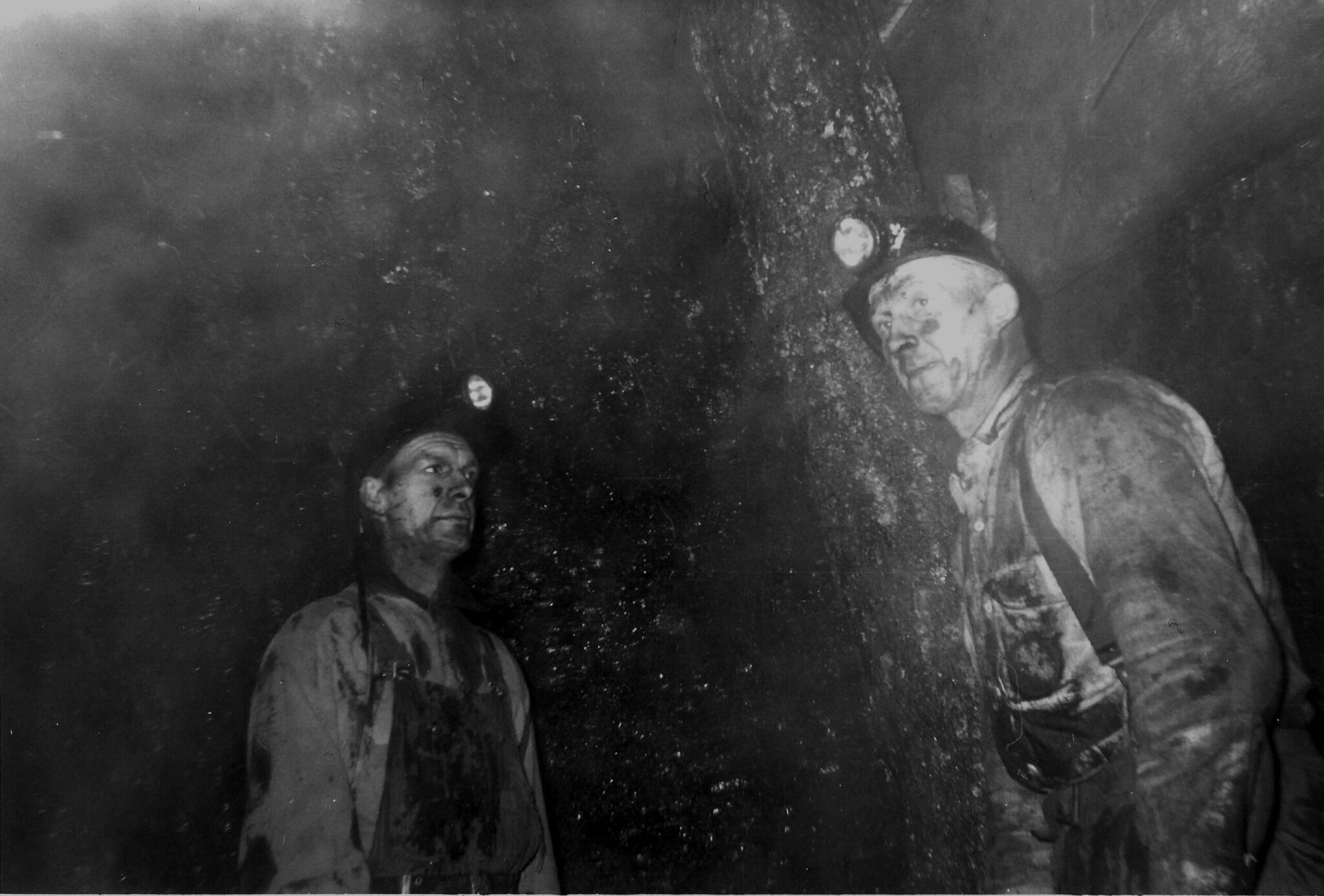
When this December 1959 photo of Grover Smail, left, and George Savicke was taken in the Rogers No. 1 mine, near the Cedar River, the new operation had been opened for less than twelve months. Sixteen years later, its successor, Rogers No. 3 on the Ravensdale side, closed on December 17, 1975. That date marked the end of nearly 122 years of underground coal mining in Washington. The territory’s first mine was launched in 1853 at Bellingham Bay, on a coal seam discovered by Captain William Pattle.
Coal mining in Washington grew slowly through its first three decades. By 1883, Washington’s mines produced less than 250,000 tons of coal per year. With the arrival of the railroad, coupled with demand from energy-hungry California, production exploded. Seventeen years later, at the turn of the century, 2.4 million tons, nearly 10 times more coal, were extracted from Washington’s mines. Output continued to grow, and spurred by demand during World War I, coal sales peaked at 4.1 million tons in 1918. However, with the discovery of oil in California, the development of hydroelectric dams in Washington, plus conversion of railroad locomotives to diesel, coal began a steady decline. Over the next 40 years, annual coal production fell 94% to 250,000 tons.
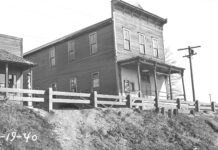
Ravensdale was a successful coal mining town from 1900 until the catastrophic explosion in 1915 that claimed 31 lives. Ravensdale was a company town owned by the Northwestern Improvement Company, a subsidiary of Northern Pacific Railway. Just over a mile north, a succession of independent mines in the area of Landsburg and Danville struggled to survive, and each ultimately failed.
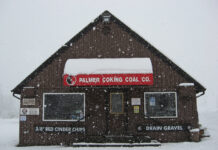
In November 1937, officials of Palmer Coking Coal Company announced plans to reopen the languished Danville mine. The Landsburg coal seam finally had an operator worthy of its potential. With more reserves opened by new investments in gangways, tunnels, and bunkers, PCCC’s mine was producing more coal than ever before. During the years of World War II, Palmer employed between 20 and 30 miners, and new operations expanded.
The various iterations of the Palmer’s operations on the Danville and Landsburg coal seams ended in 1961 after 24 years of mining, in which nearly 663,000 tons of coal was produced. But in 1959, in the same area, a new mine opened on a new coal seam with a new name. The recently discovered seam was parallel to the Danville-Landsburg vein. Not long after an opening was driven down the new seam, the mine encountered a geological fault, a lateral displacement caused by shifting tectonic plates.
Enoch Rogers, Palmer’s bulldozer operator, was dispatched to uncover which direction the vertically-lying seam lay. After he’d done so, miners and Palmer’s management began calling it the Rogers seam. A second entryway, closer to the Cedar River, was logically called Rogers No. 2. Both Rogers Nos. 1 and 2 were located south of the Summit-Landsburg Road near the triangular intersection where both a high and low road travel east to the Issaquah-Hobart Road.
In 1963, the Rogers No. 3 entryway opened along Kent-Kangley Road about one mile south of the first two portals. The new opening was driven underground at a 45-degree angle to intersect the workings from Rogers No. 2. The Rogers mine’s fourth and lowest level was 750 feet below the surface. The ridge that separates Summit-Landsburg and Kent-Kangley rises 220 feet above the surrounding topography.
Next week’s column continues the story of Rogers No. 3 mine, the last underground coal mine in Washington state, sealed shut by a dynamite blast 50 years ago next week. This photo from Dec. 1959 was likely taken by Evan D. Morris, a company director and second son of Palmer Coking Coal’s founder, John H. Morris.