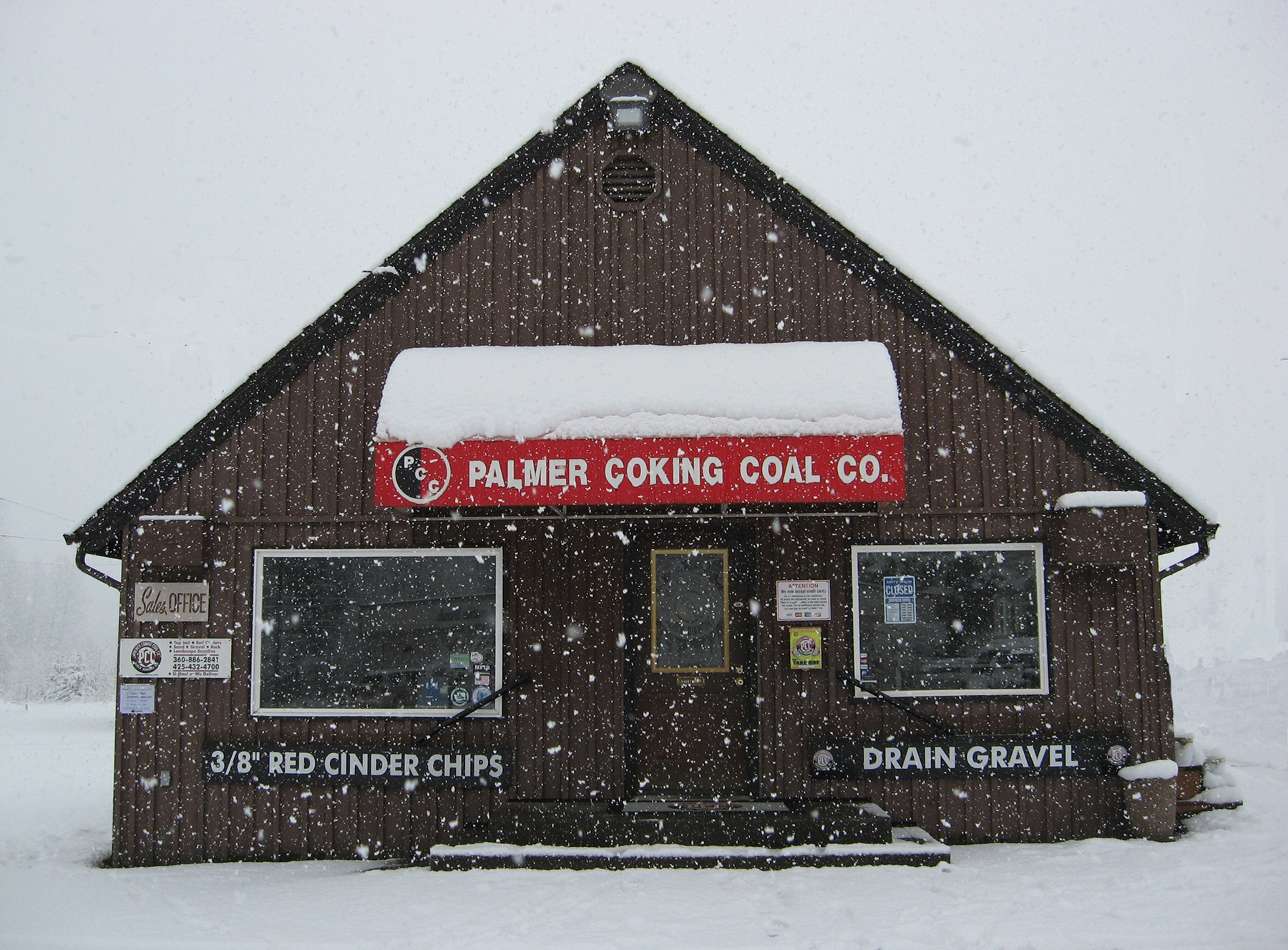
For nearly 70 years, this building has served as the mine office of Palmer Coking Coal. While Palmer closed its last underground coal mine 50 years ago, and left the coal industry 40 years back, the company has long served South King County with a wide variety of sand, gravel, and landscape materials. This Snowmageddon photo was taken Saturday, February 9, 2019, as nearly 10 inches of snow began accumulating and closed operations at their Black Diamond headquarters.
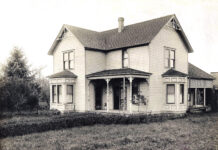
The building wasn’t always a sales office for a mining firm. It was formerly a farmhouse, built around 1932 by Martin and Magdalena Hock. The house was originally located on a parcel of land in Ravensdale, just north of Kent Kangley, west of 268th Ave S.E., and south of a small stream, sometimes called Georgetown Creek. At one point, the Hocks owned nearly 40 acres where they operated a small farm on the few flat acres near Kent-Kangley.
Marton Hack was born on Christmas Day, 1889, in the Transylvania area of Romania. He immigrated to America in 1907 with his parents and began spelling his name Martin Hock. The family first lived in Portland, where in July 1912, he married Magdalena Foushner, a Hungarian immigrant. By 1917, Martin worked as a shoemaker with the Currin-Greene Shoe Manufacturing Company of Seattle. Martin and Magdalena raised four children: Helen, born 1913; Ann, 1915; Martin, 1917; and Geza, 1920. He died in Renton in January 1962 at age 73. Magdalena passed away in August, seven months later.
Martin Hock’s employer, Currin-Green, was a prominent Seattle bootmaker, founded in 1908, and known for its durable, handmade work boots, especially cleated logging boots called caulks (pronounced corks). Their boots were popular with loggers, miners, shipbuilders, and other demanding jobs. Currin-Green’s main factory and retail store was located at 2715 Western Avenue, a 1920 building with a tower clock. Their merchandise was sold through stores like Carl Schermer. Hock labored for the company all of his career, until retiring in the 1950s.
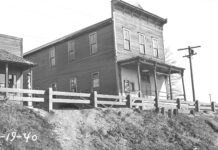
Around 1950, Palmer Coking Coal began acquiring properties between Kent-Kangley and Summit-Landsburg Roads for the expansion of their Danville and Landsburg coal mines. Palmer purchased property from a number of owners, including the Hocks, Osmond and Anne (Markus) Roberts, Birdie (Johnson) Barott, Oswald and Elnora Keller, and the Peter Mattioda family. Hock’s farm was part of the purchase, and shortly thereafter the home was moved 1/4 mile west and converted into a mine office serving PCCC’s Landsburg mine. Palmer’s main headquarters were situated at the northeast quadrant of Four Corners, the block now occupied by Fred Meyer and assorted shops. That building later became a popular café that operated as Spencer’s, Grace & Eddie’s, E-Z Eatin’ and the Summit Inn.
In 1958, Palmer concluded the purchase of most of the King County assets of the old Pacific Coast Coal Company, including its Mine 11 property on the north end of Black Diamond. That year, the Hock family farmhouse, now mine office, was moved to its present location at 31407 Highway 169.
Over the past eight decades, millions of tons of coal, sand, gravel, rock, and landscape products have passed over Palmer’s pickup and truck scales. Palmer Coking Coal Co. was founded in 1933 in Durham by four Welsh sons of George and Mary Ann (Williams) Morris, who immigrated from Wales in the early 1880s.
This snowy photo was taken by the company’s longtime and now retired manager, Bill Kombol, who also writes this column. “When Coal Was King” has been published in the Voice of the Valley since May 2007. Genealogical facts about the Hock family and business information about Currin-Green were researched by Donna Brathovde, a Ravensdale researcher and historian.
For nearly 70 years, this building has served as the mine office of Palmer Coking Coal. While Palmer closed its last underground coal mine 50 years ago, and left the coal industry 40 years back, the company has long served South King County with a wide variety of sand, gravel, and landscape materials. This Snowmageddon photo was taken Saturday, February 9, 2019, as nearly 10 inches of snow began accumulating and closed operations at their Black Diamond headquarters.
The building wasn’t always a sales office for a mining firm. It was formerly a farmhouse, built around 1932 by Martin and Magdalena Hock. The house was originally located on a parcel of land in Ravensdale, just north of Kent Kangley, west of 268th Ave S.E., and south of a small stream, sometimes called Georgetown Creek. At one point, the Hocks owned nearly 40 acres where they operated a small farm on the few flat acres near Kent-Kangley.
Marton Hack was born on Christmas Day, 1889, in the Transylvania area of Romania. He immigrated to America in 1907 with his parents and began spelling his name Martin Hock. The family first lived in Portland, where in July 1912, he married Magdalena Foushner, a Hungarian immigrant. By 1917, Martin worked as a shoemaker with the Currin-Greene Shoe Manufacturing Company of Seattle. Martin and Magdalena raised four children: Helen, born 1913; Ann, 1915; Martin, 1917; and Geza, 1920. He died in Renton in January 1962 at age 73. Magdalena passed away in August, seven months later.
Martin Hock’s employer, Currin-Green, was a prominent Seattle bootmaker, founded in 1908, and known for its durable, handmade work boots, especially cleated logging boots called caulks (pronounced corks). Their boots were popular with loggers, miners, shipbuilders, and other demanding jobs. Currin-Green’s main factory and retail store was located at 2715 Western Avenue, a 1920 building with a tower clock. Their merchandise was sold through stores like Carl Schermer. Hock labored for the company all of his career, until retiring in the 1950s.
Around 1950, Palmer Coking Coal began acquiring properties between Kent-Kangley and Summit-Landsburg Roads for the expansion of their Danville and Landsburg coal mines. Palmer purchased property from a number of owners, including the Hocks, Osmond and Anne (Markus) Roberts, Birdie (Johnson) Barott, Oswald and Elnora Keller, and the Peter Mattioda family. Hock’s farm was part of the purchase, and shortly thereafter the home was moved 1/4 mile west and converted into a mine office serving PCCC’s Landsburg mine. Palmer’s main headquarters were situated at the northeast quadrant of Four Corners, the block now occupied by Fred Meyer and assorted shops. That building later became a popular café that operated as Spencer’s, Grace & Eddie’s, E-Z Eatin’ and the Summit Inn.
In 1958, Palmer concluded the purchase of most of the King County assets of the old Pacific Coast Coal Company, including its Mine 11 property on the north end of Black Diamond. That year, the Hock family farmhouse, now mine office, was moved to its present location at 31407 Highway 169.
Over the past eight decades, millions of tons of coal, sand, gravel, rock, and landscape products have passed over Palmer’s pickup and truck scales. Palmer Coking Coal Co. was founded in 1933 in Durham by four Welsh sons of George and Mary Ann (Williams) Morris, who immigrated from Wales in the early 1880s.
This snowy photo was taken by the company’s longtime and now retired manager, Bill Kombol, who also writes this column. “When Coal Was King” has been published in the Voice of the Valley since May 2007. Genealogical facts about the Hock family and business information about Currin-Green were researched by Donna Brathovde, a Ravensdale researcher and historian.
For nearly 70 years, this building has served as the mine office of Palmer Coking Coal. While Palmer closed its last underground coal mine 50 years ago, and left the coal industry 40 years back, the company has long served South King County with a wide variety of sand, gravel, and landscape materials. This Snowmageddon photo was taken Saturday, February 9, 2019, as nearly 10 inches of snow began accumulating and closed operations at their Black Diamond headquarters.
The building wasn’t always a sales office for a mining firm. It was formerly a farmhouse, built around 1932 by Martin and Magdalena Hock. The house was originally located on a parcel of land in Ravensdale, just north of Kent Kangley, west of 268th Ave S.E., and south of a small stream, sometimes called Georgetown Creek. At one point, the Hocks owned nearly 40 acres where they operated a small farm on the few flat acres near Kent-Kangley.
Marton Hack was born on Christmas Day, 1889, in the Transylvania area of Romania. He immigrated to America in 1907 with his parents and began spelling his name Martin Hock. The family first lived in Portland, where in July 1912, he married Magdalena Foushner, a Hungarian immigrant. By 1917, Martin worked as a shoemaker with the Currin-Greene Shoe Manufacturing Company of Seattle. Martin and Magdalena raised four children: Helen, born 1913; Ann, 1915; Martin, 1917; and Geza, 1920. He died in Renton in January 1962 at age 73. Magdalena passed away in August, seven months later.
Martin Hock’s employer, Currin-Green, was a prominent Seattle bootmaker, founded in 1908, and known for its durable, handmade work boots, especially cleated logging boots called caulks (pronounced corks). Their boots were popular with loggers, miners, shipbuilders, and other demanding jobs. Currin-Green’s main factory and retail store was located at 2715 Western Avenue, a 1920 building with a tower clock. Their merchandise was sold through stores like Carl Schermer. Hock labored for the company all of his career, until retiring in the 1950s.
Around 1950, Palmer Coking Coal began acquiring properties between Kent-Kangley and Summit-Landsburg Roads for the expansion of their Danville and Landsburg coal mines. Palmer purchased property from a number of owners, including the Hocks, Osmond and Anne (Markus) Roberts, Birdie (Johnson) Barott, Oswald and Elnora Keller, and the Peter Mattioda family. Hock’s farm was part of the purchase, and shortly thereafter the home was moved 1/4 mile west and converted into a mine office serving PCCC’s Landsburg mine. Palmer’s main headquarters were situated at the northeast quadrant of Four Corners, the block now occupied by Fred Meyer and assorted shops. That building later became a popular café that operated as Spencer’s, Grace & Eddie’s, E-Z Eatin’ and the Summit Inn.
In 1958, Palmer concluded the purchase of most of the King County assets of the old Pacific Coast Coal Company, including its Mine 11 property on the north end of Black Diamond. That year, the Hock family farmhouse, now mine office, was moved to its present location at 31407 Highway 169.
Over the past eight decades, millions of tons of coal, sand, gravel, rock, and landscape products have passed over Palmer’s pickup and truck scales. Palmer Coking Coal Co. was founded in 1933 in Durham by four Welsh sons of George and Mary Ann (Williams) Morris, who immigrated from Wales in the early 1880s.
This snowy photo was taken by the company’s longtime and now retired manager, Bill Kombol, who also writes this column. “When Coal Was King” has been published in the Voice of the Valley since May 2007. Genealogical facts about the Hock family and business information about Currin-Green were researched by Donna Brathovde, a Ravensdale researcher and historian.