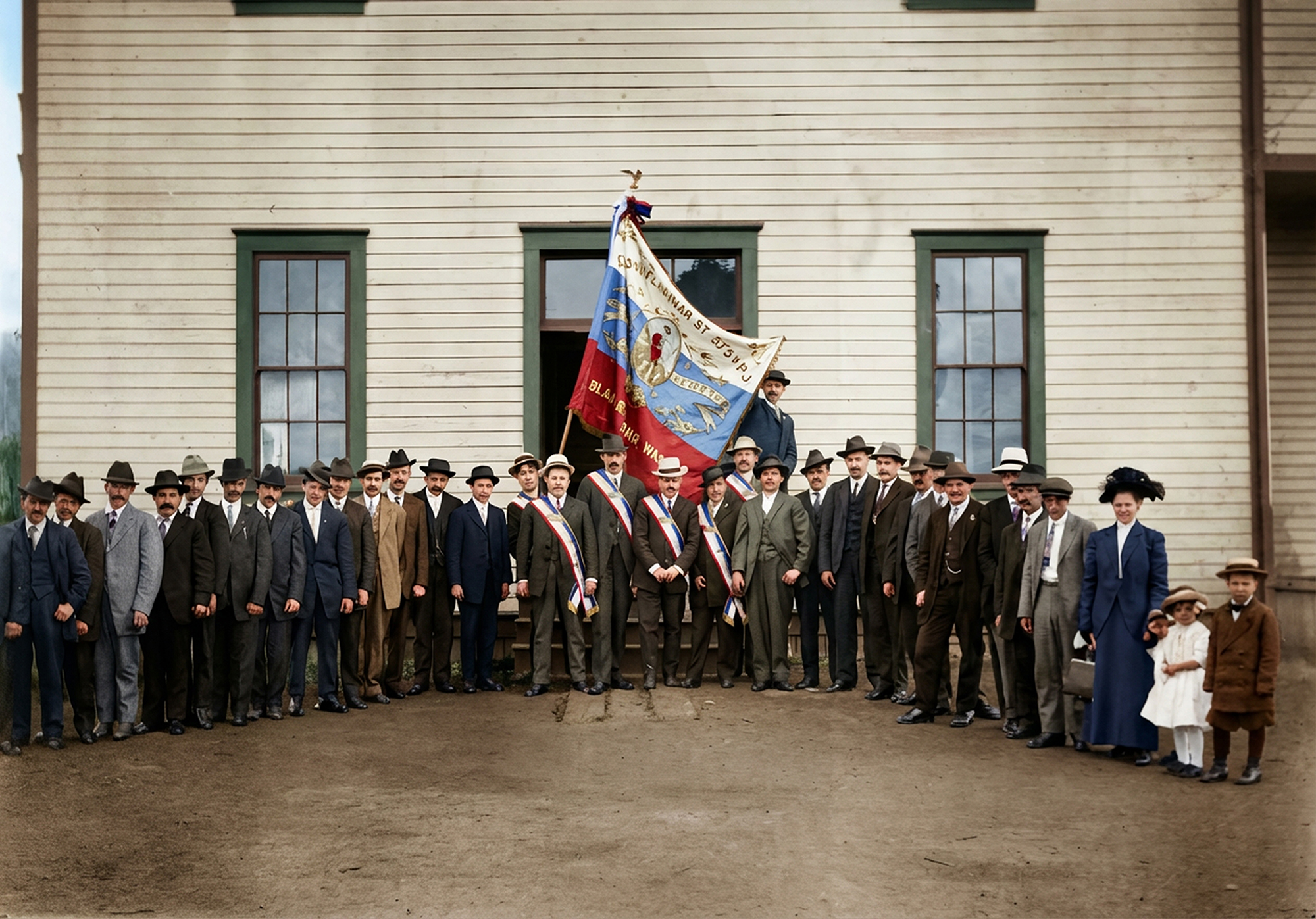
In 1907, thirty Slovenian men, one woman, and two children gathered in front of the Black Diamond Hall to celebrate the chartering of Lodge 57 of the Slovene National Benefit Society. The flag in the photo is dated February 24, 1907. The lodge hall was located east of Railroad Avenue, across the street from the present-day Smokehouse & More. The Smoke House is situated on the same lot where the historic meat markets of Pete Fredrickson and Frank Zumek once occupied.
After its founding in 1882, Black Diamond’s coal mines were magnets for immigrant miners. The Black Diamond Coal Mining Company, which relocated its operations from Nortonville, California, in pursuit of high-quality coal in the Green River district, was primarily composed of Welsh miners. Their long history of coal mining in Wales led many into management roles. The Welsh were followed by waves of Italians, who accounted for the majority of emigration during the 1890s. As the century turned, many Slavic people, including Slovenians, Croatians, Serbians, and Poles, began arriving to join the workforce that powered Black Diamond’s booming economy. By the end of World War I, Slovenia was incorporated into the new nation of Yugoslavia (meaning South Slavs), before regaining its independence in 1990.
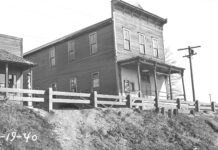
Behind the assembled Slovenians stood the lodge hall, which King County Assessor records date to 1898. However, it was actually constructed much earlier, likely in 1885 or 1886. As Carl Steiert, founder of the Black Diamond Historical Society, explained, “It was one of the first buildings the company built.” Although the surrounding land was covered with bountiful forest, there was no sawmilling equipment available, so the lodge hall was constructed largely from redwood brought up from California.
The 30-foot-by-70-foot structure had two stories. The upper floor housed the lodge hall, which doubled as a dance floor. The lower level was a show hall for live performances. Later, it was converted into a show hall where movies were shown.
Fraternal organizations experienced rapid growth in the United States during the late 19th and early 20th centuries as industrialization and immigration reshaped American life. Groups such as the Freemasons, Odd Fellows, Knights of Pythias, and numerous ethnic and religious lodges offered members a sense of belonging and stability in a fast-changing society.
The Slovene National Benefit Society (Slovenska Narodna Podporna Jednota or SNPJ), was founded in 1904by immigrants to the United States. Like other fraternal bodies, the Slovene Society offered financial security, life insurance, and sickness benefits, while fostering solidarity among Slovenians far from their homeland. There were four SNPJ lodges in Washington State –Roslyn, Ravensdale, Black Diamond, and Cle Elum. Not surprisingly, all were coal mining towns.
Fraternal organizations were particularly appealing to working-class men seeking fellowship while navigating uncertainties of life in a new country. SNPJ supported cultural events, published newspapers, promoted education, and encouraged civic engagement within Slovene-American communities. The organization grew steadily, reaching peak membership between the 1930s and 1950s.
By the second half of the 20th century, fraternal organizations, such as SNPJ, experienced gradual declines in membership. Many factors contributed to the loss. The expansion of government welfare programs and employer-based benefits reduced the need for mutual aid societies. At the same time, increased leisure options, particularly television, provided competition for associations that relied on in-person meetings to promote brotherhood and retain members. The assimilated second or third generations often found formal rituals outdated. The changes left fraternal groups struggling to adapt in a society whose citizens no longer relied on them for material support or social connections.
Black Diamond still boasts three social organizations – the Fraternal Order of Eagles, Freemasons, and the Sons and Daughters of Italy. The Freemasons are the town’s oldest, dating to November 1891, when Hugh Evans, John M. Phillips, Alexander Turnbull, William T. Jones, John Hamilton, Charles Peacock, Emilien Pommell, George F. Jones, Thomas Tonkin, David Webber, and R.A. Langford opened Diamond Lodge #83.
This photo comes courtesy of JoAnne Matsumura, an Issaquah historian. Colorization was undertaken by ‘Boomer’ Burhnam, a Tahoma photographer instructor doing business at Boomers Photography. Information about the Slovene National Benefit Society was provided by Gary L. Gorsha, former President of SNPJ Lodge 738, who has created several websites documenting information on Slovenes and their lodges.