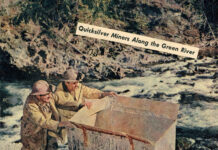
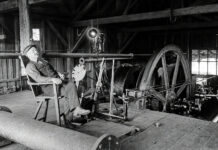
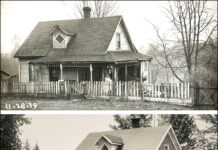
The town of Franklin was established for coal mining and operated as a company town from 1885 to 1922. At its peak, there were approximately 1,100 people living in Franklin. The town’s beginning and purpose were linked to 50-million-year-old coal seams exposed along the deep gorge cut through bedrock.
Explorers discovered coal while traveling up the Green River Gorge in the early 1880s, leading to the founding of Franklin and Black Diamond. The Columbia & Puget Sound Railroad was extended from Renton in 1885, allowing coal production to commence and both towns to develop. Franklin was named for the American patriot, Benjamin Franklin.
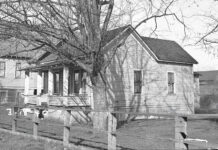
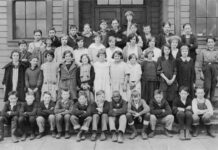
Franklin was originally owned by the Oregon Improvement Company (OIC). It had company-owned housing, a company store, post office, school, a Knights of Pythias hall, and two saloons to serve the 300-400 coal miners who worked the mines. The first shipment of coal left Franklin in June 1885.
The early years were dominated by labor strife and mining disasters. In 1891, a series of labor disputes led OIC to recruit African-American workers from the Midwest, who rode trains with their families to Washington, where they were promised good jobs. Instead, they were to be strike-breakers.
Violence erupted that spring. Following at least two deaths, the National Guard was deployed to restore peace. Unionizing efforts collapsed, while some Blacks left town. The remaining Blacks worked side-by-side with White miners. Three years later, a tragic fire claimed the lives of 37 miners on August 24, 1894. It was the second-worst coal mine disaster in Washington state history.
In 1896, the OIC was bought out by Pacific Coast Company, a conglomerate comprised of coal mines, railroads, and steamships. Pacific eventually operated mines in Newcastle, Issaquah, Black Diamond, Carbonado, and Burnett.
Coal mining in Franklin expanded, and by the late 1890s and early 1900s, production averaged nearly 200,000 tons per year. In 1908, coal output slumped, and employment fell to fewer than 150 miners. There would be one last hurrah called the Cannon Mine, which opened in 1913. However, it never lived up to its promise, and by 1922, underground coal production ceased. The town was vacated except for a few families who purchased land and ran farms.
Several small mines operated in the mid-1930s but were not successful. During World War II, the old Franklin mine was reopened, but that effort was deemed a failure. Over the first 100 years of operations, 4.15 million tons of coal were produced from the Franklin field. However, the area had one of the poorest safety records with 88 fatalities recorded during the first four decades of mining.
After the war, Palmer Coking Coal Company (Palmer) leased the properties and began surface mining combined with underground operations. In 1953, Palmer purchased the King County property and mineral holdings of the Pacific Coast Coal and continued underground mining in Franklin until 1971, and surface mining until 1981. The Black Diamond-based company still manages the resource lands of Franklin Hill for timber harvests, reforestation, and a rock quarry.
In 1973, Palmer sold most of the old town of Franklin, the vertical shaft, and the cemetery to Washington State Parks as part of their Green River Gorge Conservation Area. In 1983, Green River Community College conducted an extensive historical and archaeological project of the townsite under the leadership of Gerald Hedlund and Mark Vernon. The site was investigated and detailed in a 1994 book, “From Smoke to Mist: An Archeological Study of Franklin, WA – a Turn of the Century Company Coal Town.”
This 1887 illustration of Franklin was created by Edward Lange for the company’s marketing purposes. A copy was purchased by Ernie Moore, a one-time Franklin native who wrote the 1982 book, “The Coal Miner Who Came West.” This image comes courtesy of JoAnne Matsumura, an Issaquah historian.
The collage features ten scenes of the town and the following script:
- General View of the Franklin Town & Coal Mines.
- Property of the Oregon Improvement Company – C.J. Smith, General Manager, office in the Burke Building, Seattle, Wash.
- Also showing the Franklin Coal Mines – T.B. Corey, Supt. of Newcastle and Franklin Mines, Thomas Ramsey, Franklin Mine Supt; F.P. Carmichael, Top Foreman; James Scott, Pit Foreman.
- School House – William Head, School Supt.; Miss Sadie Latham, Assistant.
- Company Store – W.A. Burleigh, Storekeeper; R.H. Irwin, Cashier; A.E. Todd and C.H. Nichols, Clerks; G.A. Dixon, Operator; C.J. Mulby, Teamster.
- Residence of C.C. Todd, Esq. ~ Justice of the Peace.
- Mt. Rainier, 14,444 feet; View of Franklin looking toward Palmer.
- Green River Bridge.
- Green River Slope – a mine on the banks of the Green River.
- And a stylized view of the School, Boarding House, and Coal Bunkers.
- Copies of this picture sent by mail, Price $1.00. Address: Edward Lange, Artist, Olympia, Wash.