Mercury has always fascinated people. It’s the only metal that is liquid at room temperature. It also has the lowest freezing and boiling points. Its name comes from the Roman god Mercury, the swift messenger, because the liquid metal moves quickly, flows rapidly, and shifts its shape effortlessly. Given its silvery color and slippery flow, mercury was historically called quicksilver. Its chemical symbol, Hg, comes from the Greek word hydrargyrum, which translates to ‘water-silver.’
Washington State is not known for mercury mining, with two exceptions. From 1913 to 1942, Morton in east Lewis County was the site of the Barnum McDonnell mine, where a phenomenally rich deposit called Cinnabar Hill produced considerable quantities of mercury. Around 1954, Larry Berkshire, who as a youth lived in Palmer, was fishing in the Green River when he was drawn to a small rock at the water’s edge. The grey stone was shot through with reddish-brown streaks. Having been schooled in mining and geology at the University of Washington, Berkshire, an Enumclaw Class of 1943 graduate, took the rock home for assaying.
The reddish rock turned out to be cinnabar, a naturally occurring ore containing mercury sulfide. It was historically ground up to create a scarlet pigment known as vermilion. Four years later, in March 1958, the Washington Mining Corporation, led by Larry Berkshire and Ronald Ljungdahl, another Enumclaw and U.W. student, publicly unveiled the Royal Reward Mine. It was located between Palmer-Kanaskat and the Green River Gorge Bridge in Section 9, Township 21 North, Range 7 East. The mine’s grand opening featured dignitaries including Justice Robert Hunter of the Washington Supreme Court.
The company had purchased 80 acres along the Green River and secured leases for another 2,000 acres from Northern Pacific Railway and Weyerhaeuser. It was the first U.S. mercury-producing mine to be opened in 23 years. With $10,000 in mercury sales by March 1958, the company undertook expansion plans to achieve full production.
It seemed like a good time to do so. Mercury prices surged during World War II and again in the Korean War, where it was used in explosives and instruments tied to the defense industry. By late 1958, prices had jumped to $230 per flask (about 2.7 quarts, weighing 76 pounds). At the time, mercury was used to manufacture chlorine and caustic soda, and also in manufacturing batteries, fluorescent lights, thermostats, electric switches, and military operations.
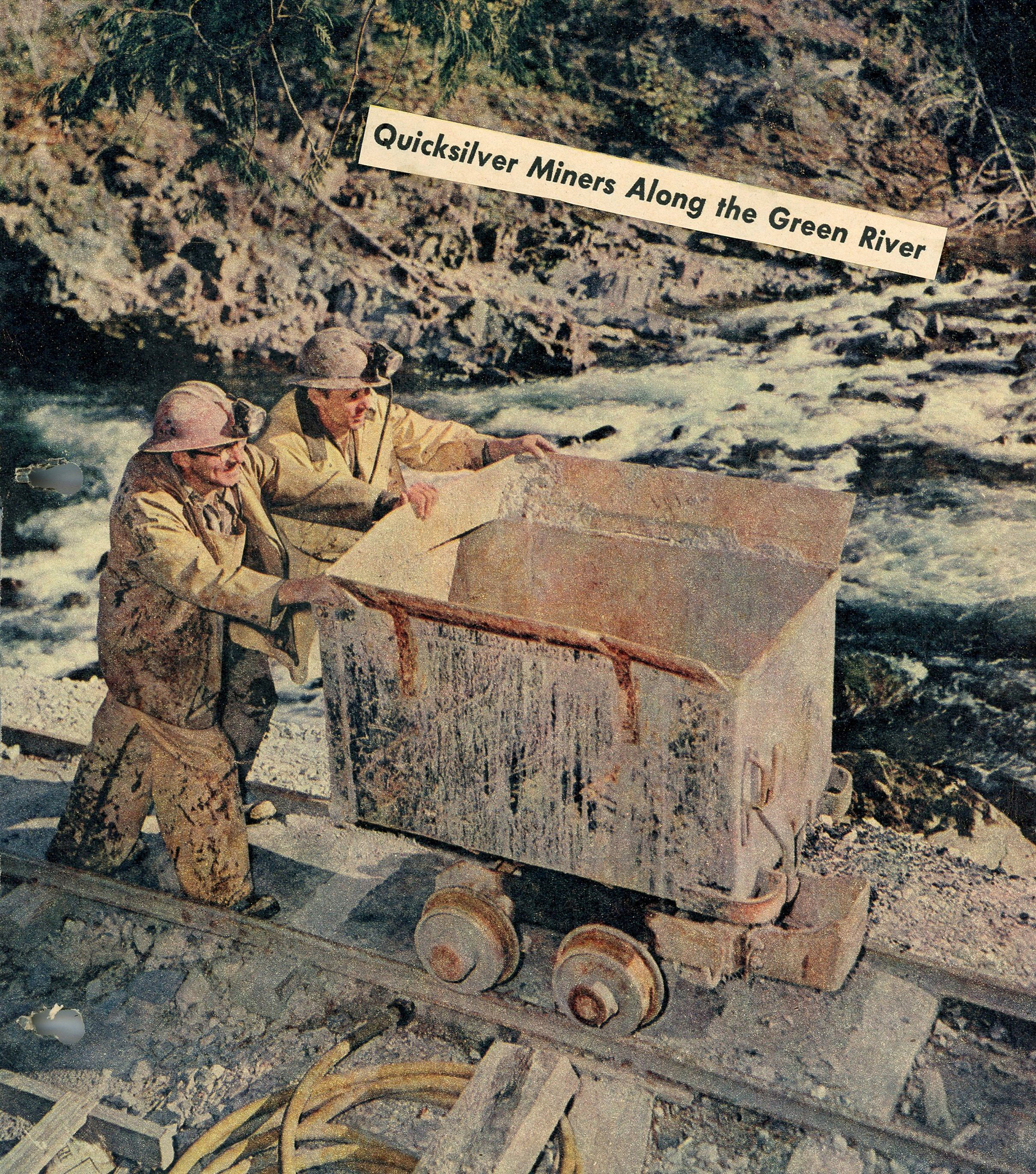
When this photo was taken in late 1958, Grant Barney, left, and Douglas Mempa were pushing an ore car towards the Royal Reward Mine on the south bank of the Green River, about four miles east of Black Diamond. The 16 miners working for Washington Mining in 1959 also included Ralph Emerson, mine foreman; Gerald Sweeney, geologist; Howard Mills, mechanic; John Keeney, Jim Crawford, E.B. Harrington, and Neil Ljungdahl. Founders Larry Berkshire and Ronald Ljungdahl worked alongside their fellow employees. Dr. Jim M. Chilson and D.D. Fitch, active stockholders, were also engaged.
Given its difficult location within the steep-walled Green River Gorge, the Royal Reward mine’s infrastructure was ambitious. A 160-foot vertical shaft was dug with a 95-foot horizontal connection. Their surface facilities were impressive, featuring a hoist, 50-kW diesel-electric power plant, 10-ton powder magazine, compressor, ore reduction plant, warehouse, lab, office, plus a changing house for miners. A sister operation called the Cardinal Reward was later opened about one mile southwest, also on the Green River.
Improvements require money, so Washington Mining sold $100 shares through newspaper advertising. Mine Superintendent, Ron Ljungdahl, was confident and bluntly predicted, “There’s about $5,000,000 in inferred ore bodies here. This could easily become a major industry in this state.” These hard rock miners were dismissive of soft rock, coal mining, Washington’s top extraction industry for much of its early history. One mercury miner disgustingly claimed, “A coal mine is nothing but a factory.”
Was it Mark Twain who claimed, “A mine is a hole in the ground with a liar up top?” By April 1959, Ljungdahl had seen enough. In a “to whom it may concern” letter, Ljungdahl resigned his position due to being “subject to the whims and follies of organizational promoters.” His scorching missive rebuked members of the Board of Directors who put promotional expediency above legitimate mining practices. By December 1962, the jig was up – the Royal and Cardinal Reward mercury mines shut down.
The mercury operations were not the last mines to operate within the Green River Gorge. Palmer Coking Coal Co.’s No. 10 Mine remained active until March 27, 1971, when its bridge across the river and portal opening were blasted with Astrolite K dynamite. The ceremony was attended by miners, owners, and state officials anxious to purchase the property, a key component of the Green River Gorge Conservation Area. In 1973, Washington State Parks made the first of a series of land purchases from Palmer Coking Coal by acquiring Hanging Gardens and the Franklin Townsite.
As for Larry V. Berkshire and Ron E. Ljungdahl, both lived productive lives. Berkshire, a WWII Army veteran, married Mary Wilson of British Columbia and raised two children, Dan and Kristie. The family moved to Canada in 1967, where Larry died in 2016 at age 91. Ljungdahl, a WWII Army combat engineer, later worked for R.W. Beck Engineers as a design engineer specializing in dams, power generation, sewage systems, and landfill closures. Ron and his wife, Regina Elizabeth, raised a stepson, Steven R. Emery. Ron passed away in February 2000 at the age of 73.
This column is indebted to local geologist Zach Pratt’s PowerPoint, “The Mercury Mine of the Green River,” previously presented at the Black Diamond and Maple Valley historical museums. Donna Brathovde, a Ravensdale researcher, provided valuable information about the lives of Berkshire and Ljungdahl. JoAnne Matsumura and the late Craig Goodwin provided background information.