Coal mining was not simply hard work — it was dangerous work in a hazardous environment, hundreds of feet underground. Even with the most stringent safety regulations, miners faced daily risks from cave-ins, explosions, heavy machinery, electricity, and dust. During the early years of coal mining, fatal accidents were common enough that federal agencies eventually began issuing “Fatalgrams,” short bulletins describing how miners were killed so fellow workers might avoid the same fate.
In coal-mining states like Washington, inspectors regularly visited mines to ensure proper ventilation and safe practices. The first Washington State Inspector of Coal Mines report was issued in 1887, shortly after the collieries of Black Diamond and Franklin were established and began shipping coal. In Washington, coal mine production increased tenfold from 380,000 tons in 1885 to 3.9 million tons in 1910. Nationwide, coal production in the U.S. grew sevenfold from 71 million to 502 million tons between 1880 and 1910. And coal mine fatalities followed suit, jumping from 500 in 1880 to nearly 2,600 deaths in 1910.
On December 6, 1907, a massive explosion ripped through Monongah mine in West Virginia, claiming the lives of at least 362 coal miners. The catastrophe shocked the nation, and in 1910, Congress created the United States Bureau of Mines. The Bureau’s mission was to improve mine safety, investigate accidents, train mine rescue teams, and conduct research on safer mining practices. Over time, the agency became a national leader promoting mine safety by reducing fatalities through better ventilation, explosives handling, gas detection, and emergency rescue techniques.
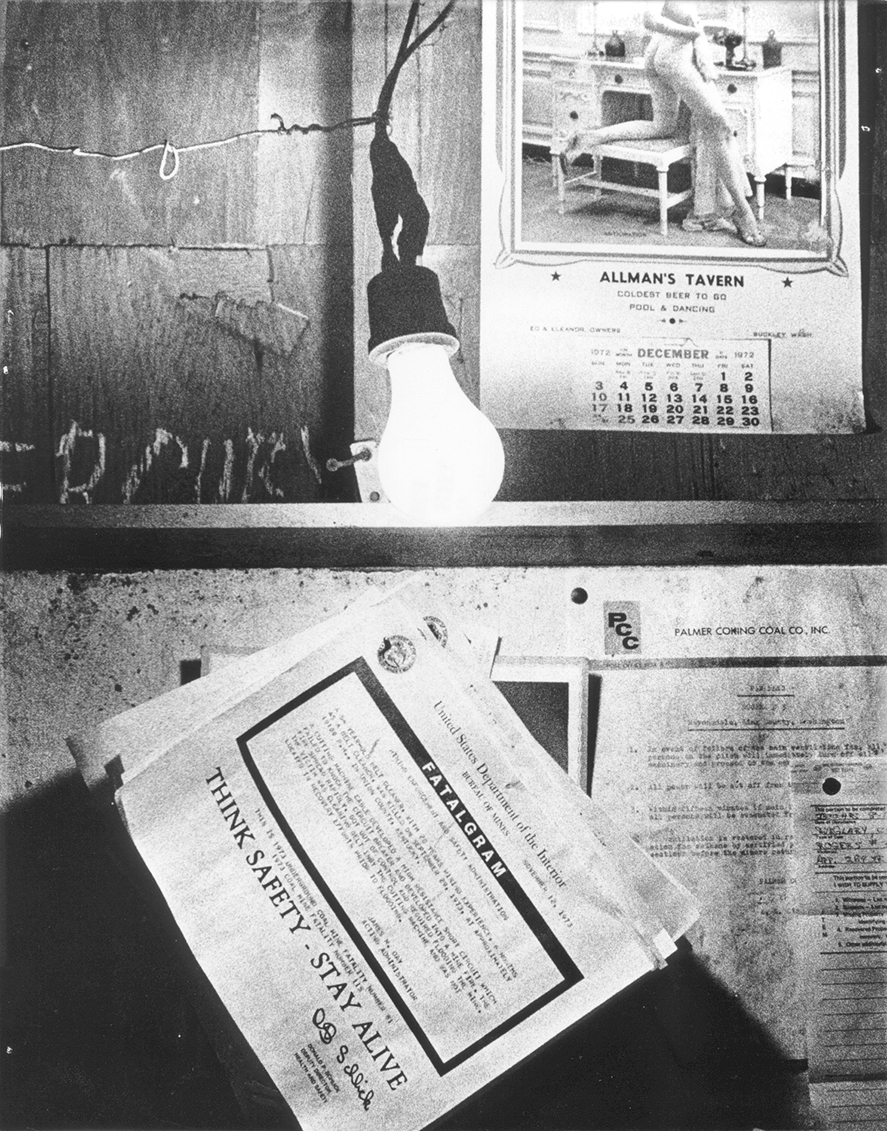
One of those techniques was education. Fatalgrams became an effective way to capture miners’ attention with a one-page, plain-language description of how each fallen miner met his maker. This 1974 photo was taken in the hoist room of Palmer Coking Coal Company’s Rogers No. 3 mine in Ravensdale. Hanging on the wall, the Fatalgram recounted a September 29, 1973, fatality involving a 54-year-old miner. The accident occurred when an out-of-control mine fire was extinguished by flooding the Union County, Kentucky, coal mine. According to the November 12, 1973, Fatalgram, one miner remained on the flooded level, unaccounted for, before the order was given. William R. “Bob” Collins drowned in the Island Creek Coal Company’s Hamilton No. 1 mine as a result of the accident.
Above the Fatalgram, a jury-rigged light bulb offered an obvious safety hazard, while an outdated 1972 calendar from Ed and Eleanor Allman’s Tavern of Buckley quietly acknowledged the coal miners’ daily experience when entering the hoist room where their electric headlamps were charged each night. Washington State’s last recorded underground coal mine death occurred on February 2, 1960, when Querino Sanchez, age 49, was electrocuted at Roslyn’s No. 9 mine.
While Fatalgrams were developed primarily for the coal industry, over time, they became a standard safety education tool for all types of mining, both underground and surface. The standard Fatalgram describes the incident, details the type of mine, the materials mined, the victim’s experience level, and concludes with safety tips to prevent similar accidents in the future