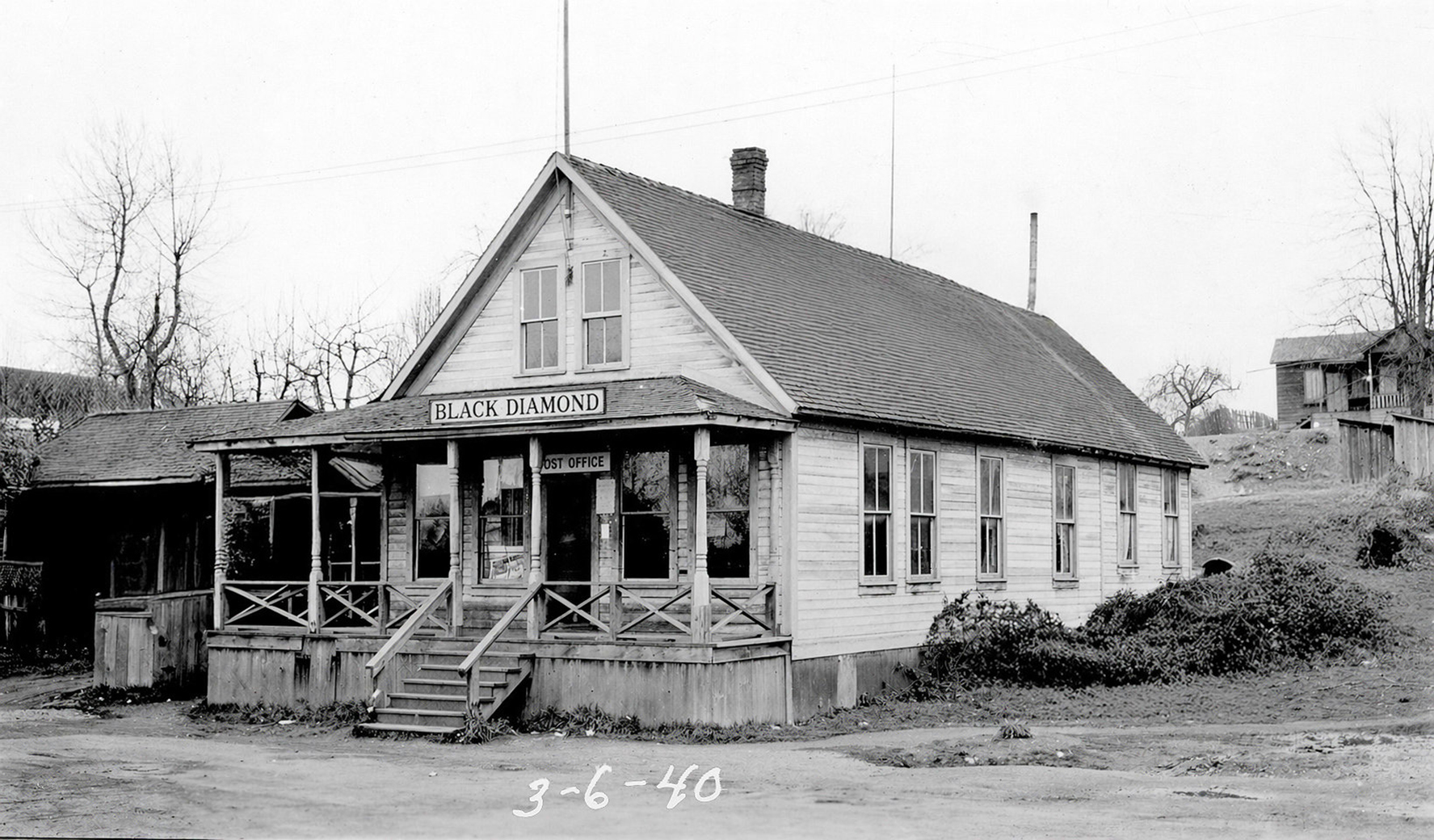
Images like this March 6, 1940 photograph of the Black Diamond Post Office are portraits in time, offering only a pale glimpse into that bygone world. At the time, coal mining was a struggling remnant from the boom days of the early 1900s when Black Diamond’s population peaked at roughly 3,500. By 1940, it was 1,018, a 70% drop. In August 1941, the New Black Diamond Mine, opened to great fanfare in 1926, closed permanently.
Just months after the first trainloads of coal left Black Diamond, the post office officially opened in the railroad depot on July 22, 1885, with William B. Jones as first postmaster. A year later, on July 24, 1886, Albert Marsden Brooks moved the post office to his store, the current location of Black Diamond Antiques. Brooks left to become postmaster in Seattle and was replaced by William H. Murray in 1889. Isaac P. Calhoun served less than a year, succeeded as Postmaster by Thomas Thomas, who undertook its relocation to the building on the corner of Baker Street and Railroad Avenue, which later housed a bank, a drug store, a confectionary, an antique store, Black Diamond Pizza & Deli, and today, the Black Diamond Grill. In a June 1902 article, Charles McKinnon came next in 1900 and remained in the position until 1915.
In 1901, after the establishment of the coal mining town of Lawson on the outskirts of Black Diamond, a new post office opened there with Gus Jones as postmaster. Lawson was alternately called McKay, the name of the coal seam that both Eugene Lawson and Pacific Coast Coal Company were mining. That post office closed shortly after the November 6, 1910 Lawson Mine explosion that claimed 16 lives and resulted in many homes and buildings being relocated to Black Diamond.
Curiously, the King County Assessor record dates this building to 1910, so it possibly came from Lawson. On June 6, 1913, a fire ripped through downtown Black Diamond, completely destroying Frank Bishop’s Black Diamond and Gibbon Hotels, Pete Fredrickson’s Meat Market, J.H. Bowen’s home, while damaging the post office building owned by Charles McKinnon, and John E. Davies’ Ice Cream Parlor.
William R. Whitlock became postmaster in 1915 and is credited with that year’s relocation into the building shown in this 1940 Assessor photo of tax parcel #084400-0490, with photo enhancements by Boomers Photography. The structure was previously occupied by a tailor shop run by George Porenta, a prominent Slovenian immigrant who died at age 82 in 1957 and is buried in the Black Diamond Cemetery. The post office remained in this location for the next 33 years.
Fred Tonkin became postmaster in 1923, serving until he became disabled. His wife, Annetta Tonkin, assumed official duties until 1937. Next in line was Raymond V. Rosso, who served as postmaster for the next 30 years.
In March 1946, Pacific Coast Coal Co. sold this building and the two lots it occupied to L.L. Shaneyfelt of Enumclaw. Two years later, the post office vacated the structure, which remained standing until the early 1960s. Then in 1954, John H. Morris, President of Pacific Coast Coal & Oil and Palmer Coking Coal, sold the adjacent lot to Frank and Tom Zumek. Today those three properties are the site of the Black Diamond Fraternal Orders of Eagles lodge, built in 1964, and the adjacent parking lot.
In August 1948, the post office moved to the old Masonic Hall at the corner of Highway 169 and Baker Street. There it occupied a small space on the first floor of the two-story wooden building. On December 30, 1966, Frank R. Costi, age 46, was named acting postmaster, becoming full postmaster on July 23, 1968. Costi was the driving force behind the construction of the current Black Diamond Post Office, located on Baker Street and 2nd Avenue, one block west of its former Masonic Hall site.
The new facility was constructed at a cost of $25,000 and officially dedicated on June 6, 1970, with a program that featured remarks by Congressman Floyd Hicks, Mayor Vic Weston, a reading by Joyce Dal Santo, and the Enumclaw High School band playing the National Anthem as Boy Scout Troop 477 raised the flag.
The 2,176-square-foot masonry structure is now owned by the Enumclaw School District and leased back to the post office. Frank Costi retired as postmaster in 1976. The following postmasters have served Black Diamond since: Gerald H. Mongrain, Linda A. Curtis, Timothy J. Stipek, JoAnn M. Larson, Roxanne E. Nelson, and currently, Juliet McClain, with several officers-in-charge in between. Much of this history comes courtesy of the Black Diamond Historical Society’s newsletters and their former archivist, JoAnne Matsumura.
Over the years, Black Diamond has been promised a new post office, but nothing has ever come of it. In 1998, U.S.P.S. real estate specialists addressed the November 26th Black Diamond council meeting and informed the city of their intention to build a 5,400-square-foot facility in the city. A two-acre site was chosen on the east side of Highway 169 near the Coal Car triangle, but by 2002, the post office suspended the planned acquisition. Again in 2019, the Postal Service spoke of relocating to a new site, the recently vacated Columbia Bank building, but the U.S.P.S. plans fizzled
Regardless of its location, the post office continues to be an integral part of a town’s culture, not only for mail, but as a place where patrons chat with friends and neighbors. It has been and hopefully always will be an important part of the community fabric in Black Diamond.