The late 1700s saw explosive growth in coal use, driven by the Industrial Revolution. The prime mover was James Watt’s steam engine, which required massive amounts of fuel to boil water and generate steam. Coal contains roughly 1.5 to 2 times more energy than firewood, plus it’s far denser, delivering four times more power by volume.
Next came Henry Cort’s invention of better-quality iron with coal-derived coke replacing wood charcoal. Meanwhile, Western Europe faced severe deforestation as timber prices soared to meet demand from the booming shipbuilding industry. With the construction of new canals and the development of railroads, it became easy to ship coal long distances. Factories no longer needed to be adjacent to rivers for water power.
The coal industry’s growth during the Industrial Revolution transformed Wales from a rural, agricultural society into the world’s first industrial nation. By 1850, more Welsh worked in industry, primarily coal mines, than on farms. With their superior mining skills, between 100,000 and 150,000 Welsh-born people immigrated to the U.S. during the 1800s.
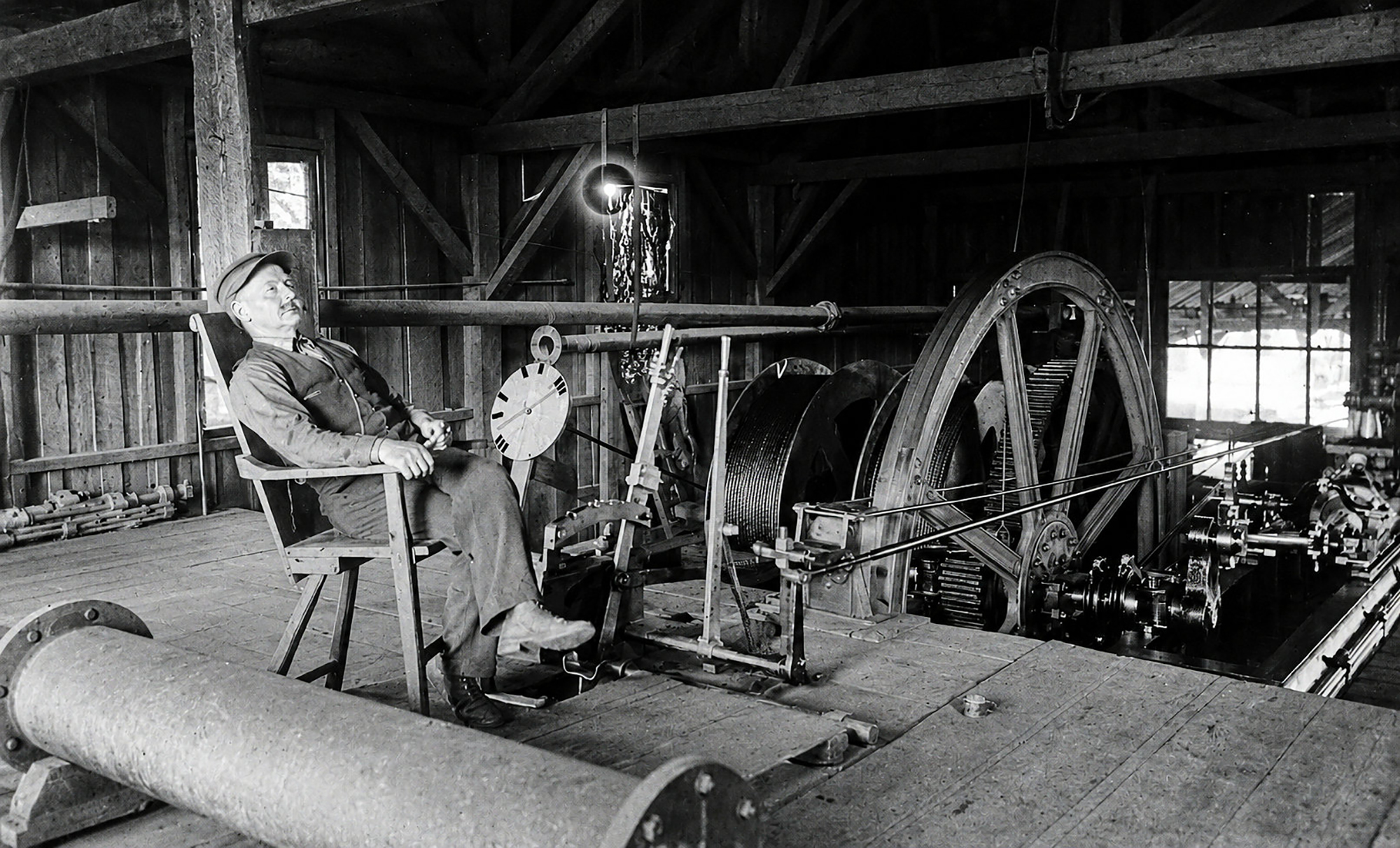
William Trevylian Thomas, seen here operating the hoist machinery at Black Diamond’s Mine 14 in the 1890s, was one of them. Born in Wales in 1860, W.T. or ‘Bill’ Thomas, as he was known, was a typical Welsh immigrant. He began working in the Welsh coal mines in 1860 at age ten. Entering the mine at 4 a.m., he labored 14 hours a day, earning “the magnificent sum of 16 cents a day.” Candles cost miners four cents each, so Thomas blew his light out while eating lunch. His meal consisted of a few slices of bread without butter or meat. He had to walk a mile through tunnels, his bare feet exposed to mud and water, to reach the mine’s working face.
He remained a coal miner who, through grit and knowledge, worked his way up through the ranks. Thomas arrived in the U.S. in 1885, at age 25, and two years later made his way to Franklin, Washington Territory. Thomas told of the time when he and 16 other miners were briefly entombed in a Franklin mine behind a raging fire. They all wrote farewell notes but miraculously dug their way out.
Thomas’ narrative, which reflected the experience of many Welsh miners, was published in the Oct. 1, 1925, issue of the Pacific Coast Bulletin. Thomas delivered it as a speech a week earlier during a luncheon of the Pacific Coast Coal Company’s Central Council of miners and managers. W.T. Thomas concluded his message by emphasizing how much better working conditions were in 1925 than two generations prior.
Thomas moved to Black Diamond in 1895 and married Hilda Agusta Paulson Nelson, a seamstress who also raised chickens and sold eggs. A son, Albert, was born in 1897 but died a year later. A daughter, Margaret, was born in 1898.
Around this time, W.T. Thomas was the hoisting engineer, responsible for pulling coal cars out of the mine and lowering empty ones down. It was one of the top jobs in the mine. And the Black Diamond Coal Mining Company’s Mine #14 was the biggest and best in the area. In the photo, Thomas is seated before a dial and a lever. To the right is the powerful hoisting machinery, basically a giant fishing reel wrapped with a one-inch steel cable. The dial indicates the position of the coal cars on their trip to or from the bottom of the mine. The lever controls the electric current that drives the hoist. Electricity was generated from a nearby coal-fired steam power plant.
Seeking to improve his lot, Thomas trained to be an agent with New York Life Insurance. It was a strategic move because New York Life had recently pioneered the sale of policies to high-risk workers such as railmen and coal miners. Most life insurance companies refused to cover miners due to high mortality rates, ceding the market to New York Life, which found a massive, untapped market in booming industrial towns like Black Diamond. To sell these high-risk policies, they needed agents who knew the industry and could communicate with miners, many of whom spoke little or no English.
William T. Thomas moved to Seattle in 1903 and continued his career as a New York Life Insurance agent. He became a U.S. citizen in 1920 and passed away in 1938. His granddaughter, Margaret Stanley, was a longtime member of the Black Diamond Historical Society and rarely missed Welsh Heritage Days.
Details about Thomas’s life were provided by JoAnne Matsumura, an Issaquah historian and former BDHS archivist. This photo #1992-01 comes courtesy of BDHS. The original was so severely faded that much of Thomas’ face was all white. Photo enhancements were performed by Boomer Burnham, who does business as https://www.boomersphotography.com/. Boomer explained that when a photo is “blown out,” there is no information to correct or alter. Boomer admitted using Artificial Intelligence “creates a lot of new details and facts.” However, the writer of this weekly column worked in and around similar coal mine hoist rooms and can attest to the generalized accuracy of Boomer’s photo upgrade.