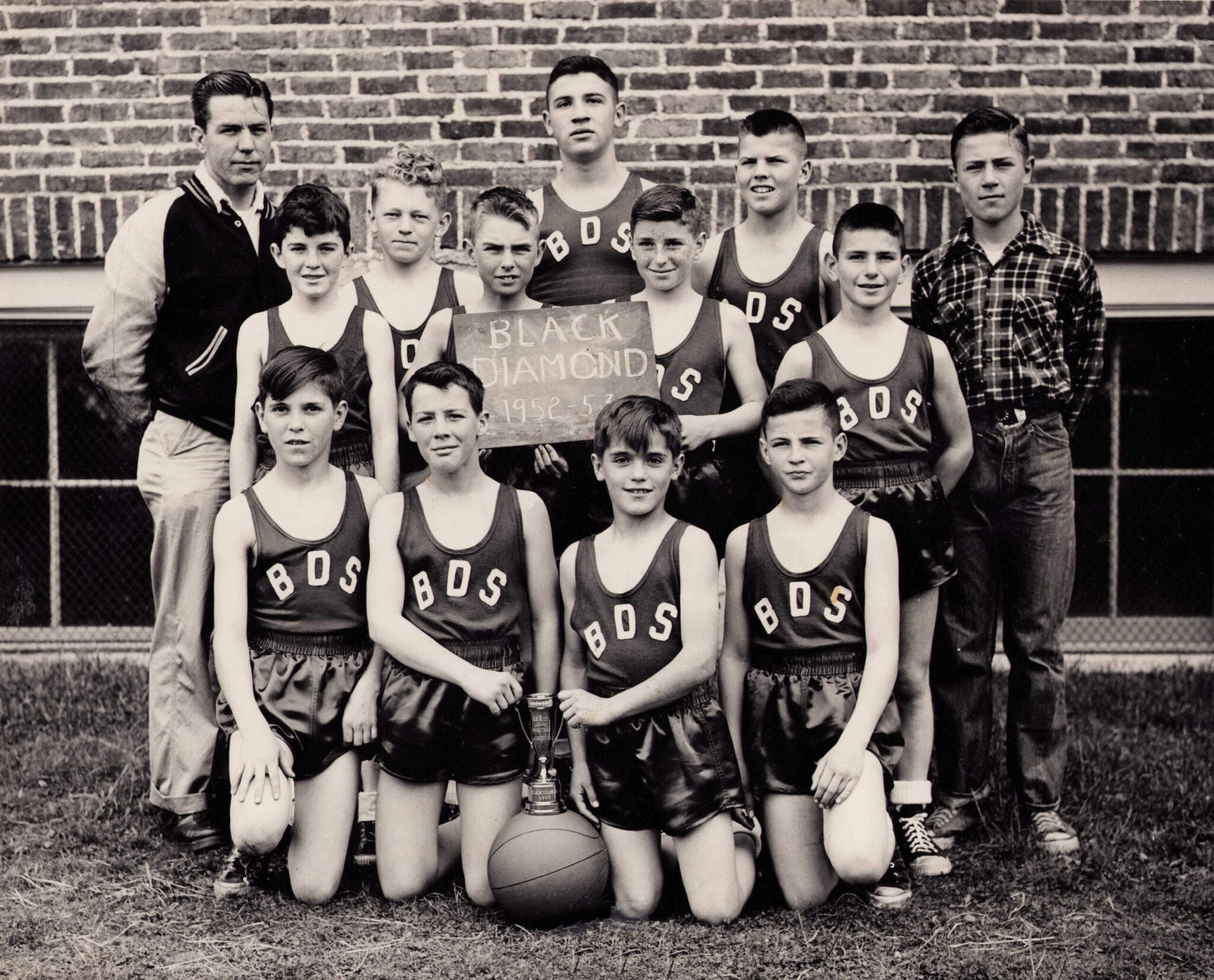
This photo of the 1952-53 Black Diamond basketball team was taken in front of the old elementary school, an impressive two-story brick building torn down in 1963. The players from left to right are, front row: Jim Carnino, Dave McCrindle, John Carnino, Chuck Capponi. Middle row: John Dodd, Cliff Johnson, Frank Manowski, Gene Marangon, George Franchini. Back row: Coach George Hazen, Harry Rossi (tallest player), Bob Lloyd, Richard Lucchesi. Four of the boys, Dodd, Manowski, Franchini, and Rossi, shared the same first name as their fathers. At the time, two of the boys, John Carnino and Frank Manowksi, were in 5th grade, while the other ten were in 7th grade.
The team’s coach, George Hazen, taught 4th grade at the Black Diamond school. Hazen was so beloved by former students that many of them went on to become schoolteachers.
One player, Bob Lloyd, had a particularly impressive basketball career. At the combined Enumclaw High School and Junior High, which the older boys entered after 7th grade, Lloyd was the team’s center and co-captain his senior year. He also led the league in scoring. Under Coach Ralph Sill, the 1958 Hornets finished 4th in the State A basketball tournament. After graduating in 1958, Lloyd attended Washington State College and made the varsity team as a freshman.
John Carnino and Frank Manowski went through 8th grade at Black Diamond, then Enumclaw; the same pattern Black Diamond students would experience over the next five decades. Frank Manowski continued his sporting career as a recreational coordinator for King County Parks, stationed at the Enumclaw field house and the old Pete’s Pool. Manowski held that job from 1965 to 1997, and over 33 years, encouraged thousands of youngsters to develop a deeper appreciation of all kinds of different sports.
Seven of the players, Capponi, Franchini, Lucchesi, Marangon, Rossi, and two Carninos were of Italian heritage and descended from coal-mining fathers and grandfathers. Gene Marangon explained that Italians were such good miners that their foreman and bosses often asked if they had friends or relatives in the old country looking for work. The Italian-Americans then sponsored the immigrants they’d urged to come.
In coal mining towns like Black Diamond, sports were a chief form of entertainment. Baseball and soccer were the two biggest, but any kind of sporting activity was treasured. Even kick-the-can was widely talked about and played daily, according to JoAnne Matsumura, former archivist at the Black Diamond Museum. Hoops of varying sizes were affixed to any old barn, shed, or vertical surface, making them makeshift basketball courts.
Until the late 1930s, Black Diamond was a company town owned by Pacific Coast Coal, which bought the mines, homes, and businesses from its founder, Black Diamond Coal Mining Co., in 1904. The Company funded and financed baseball and soccer teams and built the grandstand on the field bordering Highway 169. Around 1900, the Company made that previously swampy area available, and the miners used wheelbarrows to fill it during time off from work. A portion of the surrounding land was deeded to the school district, with a stipulation that the sporting field be forever reserved for the town folks’ use when school is not in session.
This photo comes courtesy of Black Diamond Historical Museum. JoAnne Matsumura, Gene Marangon, and Frank Manowski contributed background information.