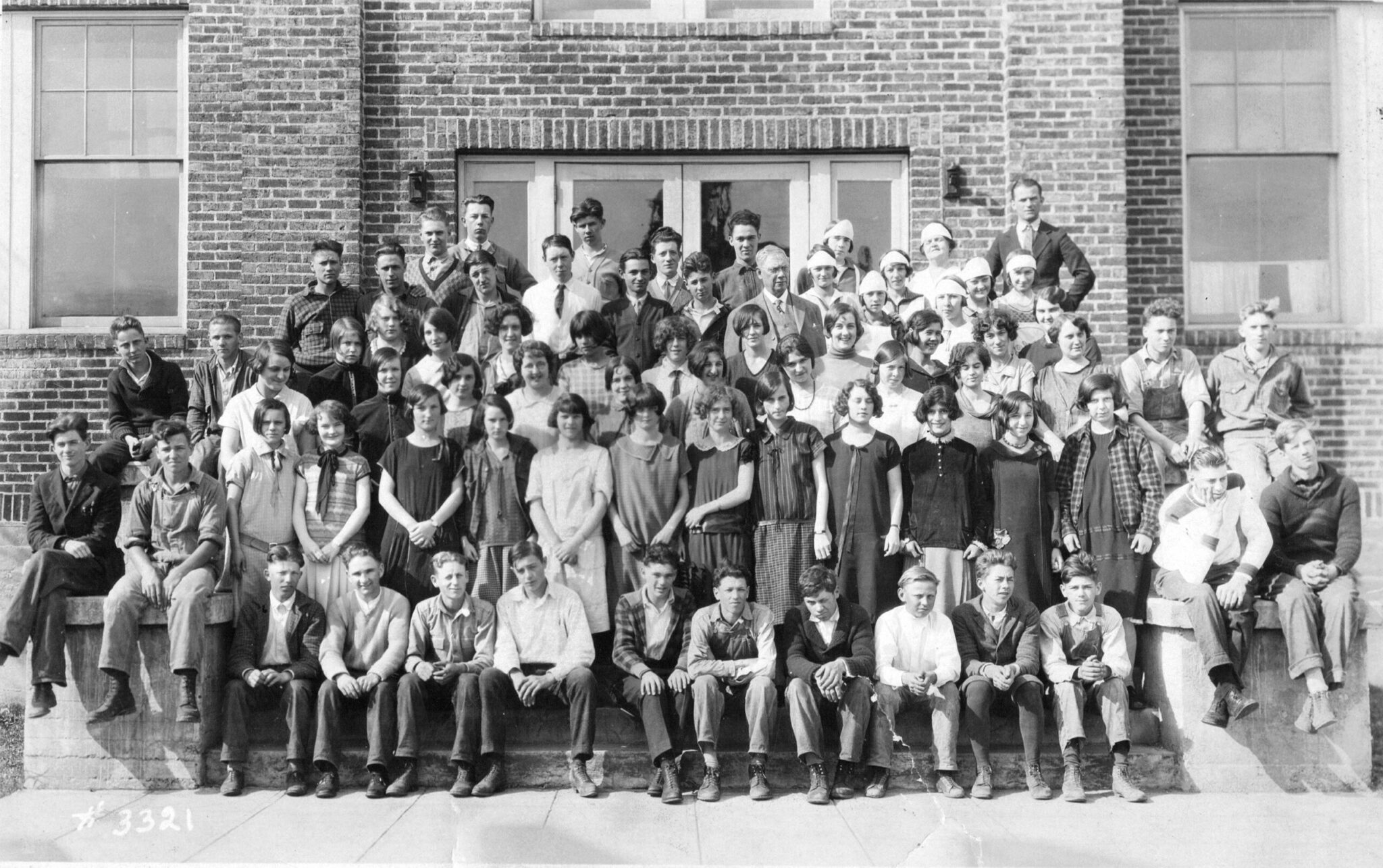
When the student body and faculty gathered in front of Black Diamond High School in 1926, little did they know that the town’s top-producing coal mine would shut down the following year. Over the previous 41 years, Black Diamond’s mines had produced more than 10 million tons of coal, the majority from Mine 11, originally called Morgan Slope. But Mine 11 would close in early 1927. Its replacement, called the New Black Diamond Mine, wasn’t even in Black Diamond. New Black Diamond was located halfway between Maple Valley and Renton, and the miners it employed would soon be boarding trains to commute to and from work.
The Black Diamond High School, seen behind the assembled students and teachers, was built in 1921. That was the same year a bitter labor dispute and company lockout divided the town, resulting in the assembly-line construction of homes for striking miners, just west of Pacific Coast Coal Company property in a new settlement called Morganville.
As coal mining diminished in importance and families moved away, Black Diamond’s school enrollment dwindled. By 1943, Black Diamond needed to consolidate, sending its high school students to Enumclaw. On July 21, 1975, Black Diamond School District #190 was fully absorbed into the Enumclaw School District. Today, through annexations and expansions, the City of Black Diamond is home to four different school districts: Auburn, Enumclaw, Kent, and Tahoma, matching several other multi-district cities in Washington.
Black Diamond’s first school, a wooden structure, likely came down in the early 1940s. The high school stood near that older elementary school, but it was demolished in 1963, making room for a new school serving kindergarten through 8th grade. That elementary school was replaced by the current Black Diamond Elementary School, which opened in September 2017. It is the fourth school to occupy that site.
In 1926, Ruth Mills, a freshman and one of 68 students, had the presence of mind to inscribe the names of every student and faculty on the back of the photo, likely taken by Frank Perkins, a Seattle-based school photographer. Ruth also wrote beside each name their class. And remarkably, she spelled most of the names correctly, a somewhat daunting task in a town of many immigrants. There were 27 freshmen, 18 sophomores, 11 juniors, 11 seniors, with one student, Bonita Goldnen, absent that day. Four teachers, Margaret Clark, Thelma Laird, Elizabeth Williams, and John Bigley, comprised the faculty, and Albert Weatherbee was principal.
Front Row, from left to right: Ray Bisyck, Oren Lile, Val Drumel, John Morganti, James Manville, Nat Pennachi, Tony Erath, Otto Mattson, Ralph Enstrom, Tom Babcanick.
Second Row: Donald Corning, Dwight Potter, Barbara Weiltsnig, Gwendolyn McDowell, Esther French, Ada Marckx, Helen Arnold, Helen Manville, Dorothy Gray, Mary Farlich, May Lewis, Esther Franchini, Clara Davis, Hazel Bremmeyer, Ronald McLean, Lloyd Winbeckler.
Third Row: Vivian Pestoresi, Margaret Murphy, Ruth Mills, Gertrude Reighmese, Edith Giss, Evelyn Tenio, Hilda Swab, Ellen Brodie, Celia Corning.
Fourth Row: Glen Rocky, Jack Roginski, Rena Banchero, Kate Plass, Ruby Favro, Agnes Drumel, Mary Richter, Alice Bryant, Helen Walters, Lillian Tenio, Mary Tratnik, Miss Margaret M. Clark (teacher), Frank Tratnik, John Babcanick.Fifth Row: Edith Lewis, Francis Marckx, Frank Guidetti, Charles Tenio, Willis Brodie, Frank Costi, Russell Plass, Mr. Albert Weatherbee (Principal), Elna Marckx, Ida Moishio, Miss Thelma Laird (teacher).
Between Fifth and Sixth Row: Elizabeth Thunkoff, Nellie Parkinson, Ellen Jackson, Francis Niemczyk.
Sixth Row: Joe Fosnick, Ray Russo, Max Page, Jim Paolucci, Adolph Tratnik, Ada Whiting, Miss Elizabeth Williams (teacher), Mr. John Bigley (teacher).
This photo by Perkins Studio comes courtesy of the Black Diamond Historical Museum. We apologize in advance for any misspelled names or misidentified individuals.