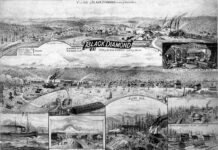
Lawson was originally a coal mine located east of Jones Lake along the Columbia & Puget Sound Railroad line. It was served by an unpaved street now called Old Lawson Road. The town was established in 1896 by Eugene Lawson, who named his colliery the Light Ash Mine. Lawson’s mine was on the McKay coal seam in Section 13, about 1/2 mile southeast of the Black Diamond Coal Mining Company’s Mine 14 in Section 14.
Lawson’s mine was soon rebranded the White Ash Mine and, in May 1899, was acquired by the Pacific Coast Coal Company (PCC), whose operations in Newcastle, Coal Creek, and nearby Franklin made it Washington’s second-largest coal producer. An October 1901 mine explosion claimed 11 lives and closed the original mine, which henceforth became known as Old Lawson.
Pacific Coast Coal immediately went to work opening a old mine about 1/2-mile to the north of New Lawson. It was situated near the end of Botts Drive. The road, which begins at Highway 169 and travels east towards Franklin, became Lawson Street in town, and the Green River Gorge Road beyond. And since the elevation rises about 150 feet between the Black Diamond and PCC’s New Lawson Mine, the surrounding area became known as Lawson Hill. The top of Franklin Hill rises to an elevation of 1,260 feet, about two miles east of that same hill.
In 1904, PCC acquired the Black Diamond Coal Mining Company’s workings and its company town, and furthered its position in Washington’s coal industry.
While Black Diamond’s mines were dominated by Welsh and British miners in the early years, and later Italians, the Lawson Mine’s workforce was predominantly German, Austrian, and Finnish. The Lawson Mines were much smaller than Black Diamond’s Mines 11 and 14. They were also far more dangerous, experiencing 34 fatalities in 15 years of operation that produced just over 1.1 million tons of coal. On a per-ton basis, Lawson recorded 33 deaths per million tons mined compared to Mine 14’s four deaths and Mine 11’s eleven deaths per million.
On Sunday morning, November 6, 1910, 11 miners were being lowered down the mine slope, while five men waited at the bottom, nearing the end of their graveyard shifts. An explosion ripped through the underground workings so powerfully that it completely destroyed the mine and wrecked surface facilities. All 16 men perished, with five bodies never found.
The cause of the explosion was never conclusively determined, though several theories were advanced. Eight of the 11 recovered miners were interred in one common grave, while three were buried elsewhere in the Black Diamond Cemetery. The five unrecovered bodies are entombed under 2,000 feet of cover, 800 feet below sea level mine. A tribute to those men can be seen at the Black Diamond Cemetery.
After the mine ceased operations, the large store on Lawson Hill was moved downtown to Railroad Avenue. Most of the New Lawson homes were relocated closer to Black Diamond’s mines. Many of them landed on 3rd Avenue (i.e., Highway 169) and Lawson Street. Today, Lawson Street remains a collection of historic miners’ homes, while the sparsely populated Lawson Hill is slated to become Oakpointe’s Master Planned Development featuring 1,200 homes and residences.
On Saturday, June 6th, the Black Diamond History Museum celebrates its 50th anniversary with a ribbon-cutting to unveil the new underground mine exhibit, complete with talking mannequins. It’s also Welsh Heritage Day in tribute to Black Diamond’s 1885 founding, whose early population was primarily from Wales. The community event, with loads of fun activities, takes place at 32627 Railroad Avenue and is, as always, FREE.
This photo comes courtesy of the Black Diamond Historical Society, with photo enhancements undertaken by Doug ‘Boomer’ Burham, dba BoomersPhotography.com