Before Morganville was developed in 1921, it was just another section of Northern Pacific Railway land, located west of coal company property in Section 14. As a part of the land grant for building a transcontinental railroad, N.P. was granted every odd-numbered section of land (640 acres) within six miles on both sides of the rail route.
Timothy Morgan was born in Wales and by 1883, made his way to Black Diamond. Though just a miner working for the Black Diamond Coal Mining Company, Morgan filed a homestead claim on a piece of property the company coveted. Tim later traded his homestead for a half-interest in a saloon. Some claim that company officials got Morgan drunk, which generated a lifelong enmity between Morgan and the coal company. Later, he tried to adversely possess land from the railroad, but lost that lawsuit, yet still ended up owning 160 acres in Section 15.
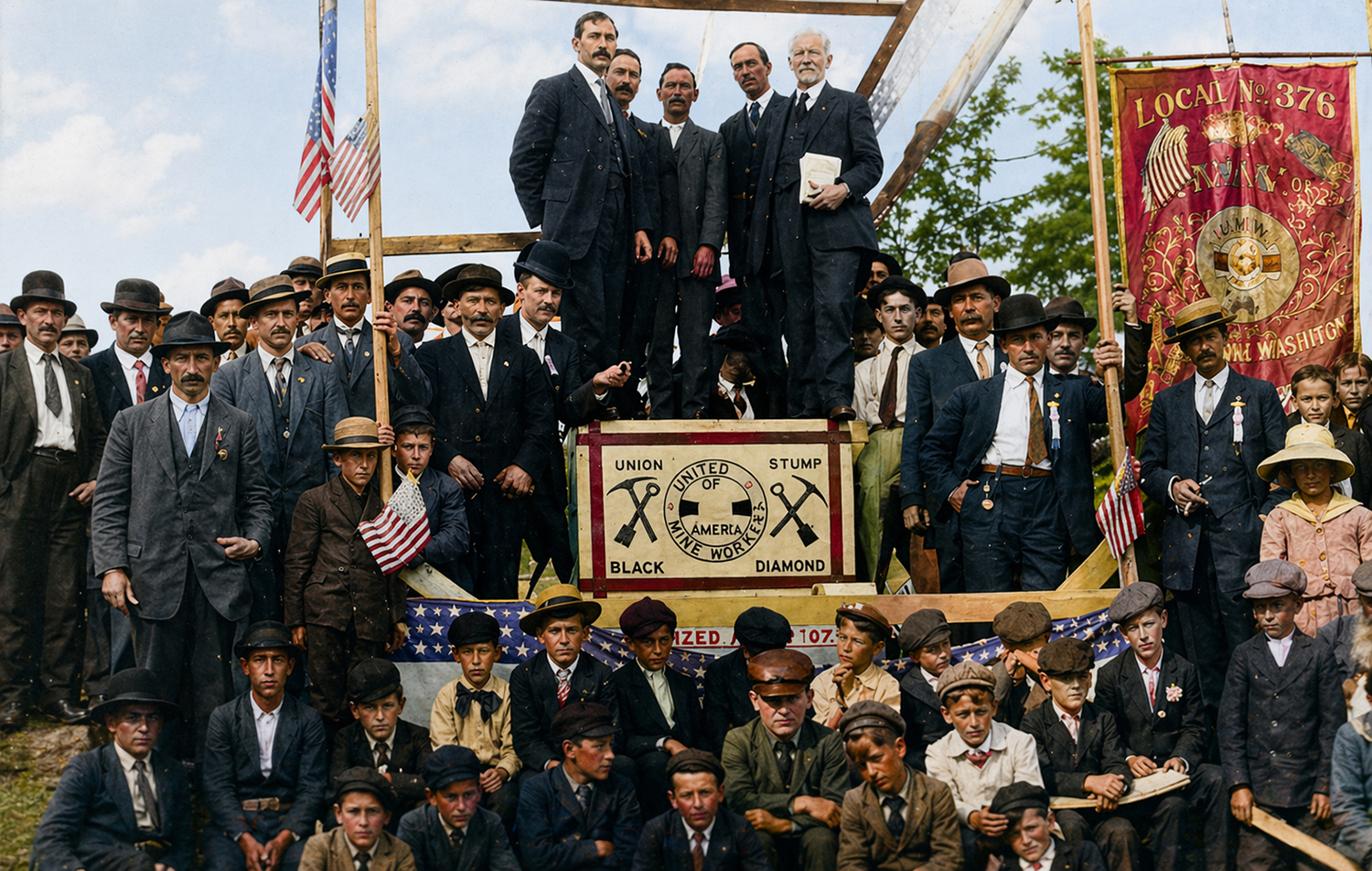
In 1907, Black Diamond’s miners wanted to join a union, but were not allowed to meet on Pacific Coast Coal Company (PCC) property. So, 200 to 300 miners walked one-half mile west on Morgan Street, just past the cemetery, onto Tim Morgan’s property. Speeches were given atop large fir stump that served as a speaker’s platform. This photo taken May 5, 1907, at Union Stump. The old-growth tree trunk is now encased in concrete and situated in Union Stump Historical Park on Cemetery Road, a short street that connects Roberts Drive to Morgan Drive.
Shortly thereafter, the United Mine Workers of America was organized. Without a strike, the UMWA obtained an 8-hour day, and wage increases for Black Diamond’s miners. And each summer thereafter, Tim Morgan hosted a picnic for coal miners.
For the next 12 years, labor peace generally held as coal prices increased and wages rose. Production boomed during World War I, and miner’s pay continued to rise. But at war’s end, coal prices fell, and output slumped. In the face of lower coal prices, companies throughout the nation sought reduced wages.
A Washington State commission was assembled and recommended a solution, which miners reluctantly accepted. However, coal operators’ losses amid falling prices were unbearable. Pacific Coast Coal and other mining companies issued an ultimatum: reinstate the October 1919 wage scale or workers would be locked out. The miners struck on March 15, 1921. On August 31, a bitter labor dispute turned ugly as union miners were forced out of company houses in the PCC-controlled town site.
Once again, Tim Morgan rode to the miners’ rescue. He offered to sell a parcel of land to the Union so striking miners could build new homes. The coal company learned of Morgan’s plans and offered him $30,000 to purchase the property. Morgan turned them down and sold the 16 acres to the Union for $2,500.
Tim Morgan nailed the plank in the first of 200 planned homes. The homes were built assembly-style by striking coal miners, most of whom knew how to handle a hammer and saw. A large two-story Union Hall measuring 36 feet by 70 feet deep was erected on Buena Vista Drive. The new townsite was laid out along two main streets that extended north and south of Roberts Drive: Morgan Drive and Union Drive, plus two connecting loops, Dail Drive and Buena Vista Drive.
The area was affectionately named Morganville, in honor of Timothy Morgan (1839-1927), husband of Esther Jane (Swansbrough), and father to 14 children, 13 of whom lived to adulthood. Morganville became part of Black Diamond when the city was incorporated in 1959.
On Saturday, June 6th, the Black Diamond History Museum celebrates its 50th anniversary with a ribbon cutting for the new underground mine exhibit, complete with talking mannequins. It’s also Welsh Heritage Day in tribute to Black Diamond’s 1885 founders, whose members were primarily from Wales. This community event, with lots of fun activities, takes place at 32627 Railroad Avenue from 10 am to 3 pm.
This photo comes courtesy of the Black Diamond Historical Society with photo enhancements undertaken by Doug ‘Boomer’ Burham, dba BoomersPhotography.com