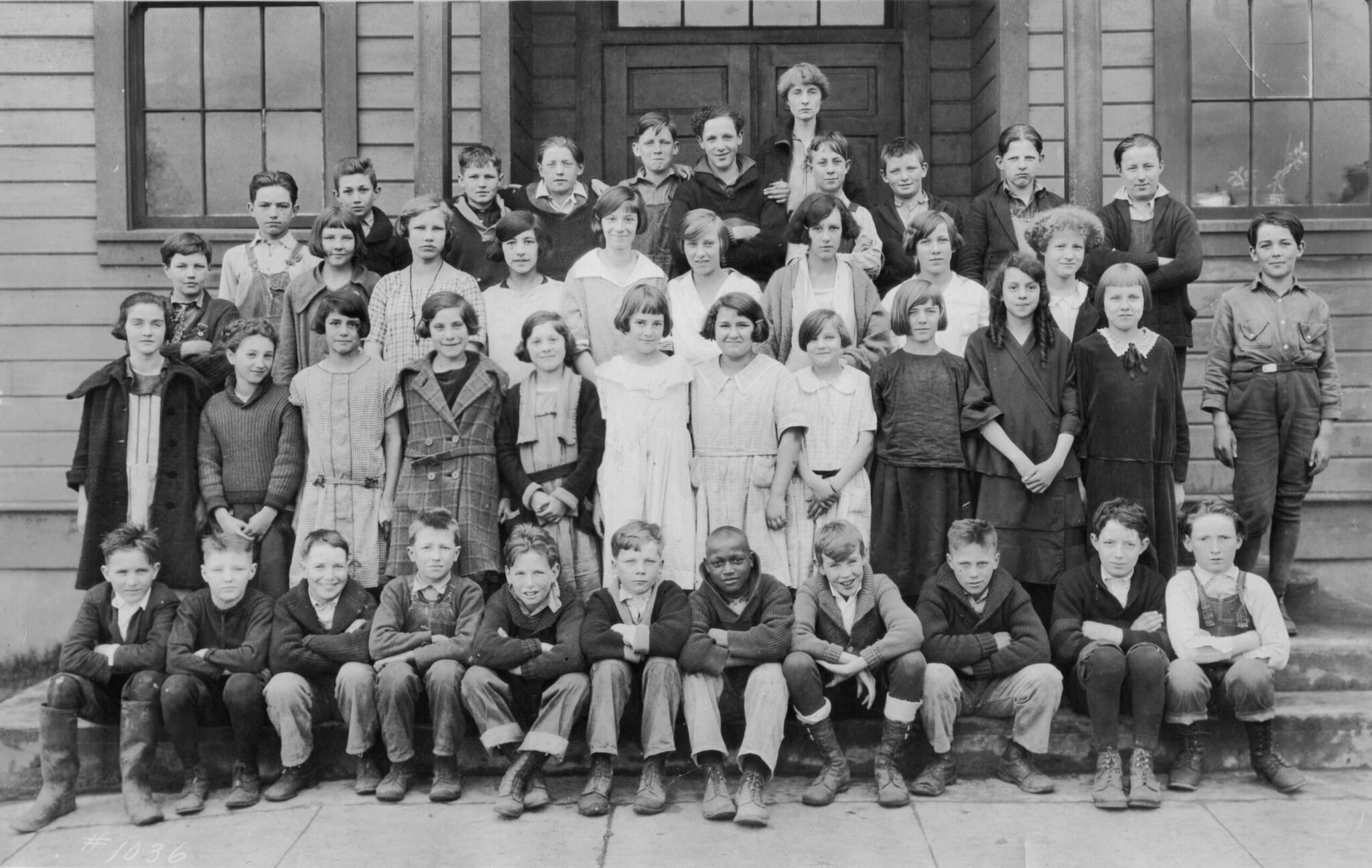
One hundred years ago, the Black Diamond junior high student body, likely consisting of 7th and 8th grades, assembled in front of the town’s first proper school building, constructed in the early 1900s. The school district was established on November 6, 1885, just three years after coal was discovered there and the Black Diamond Coal Mining Company of Nortonville, California, moved operations 800 miles north from their Bay Area founding.
In the very early years, school classes were held in family homes, the Masonic Hall, and the Congregational Church. As production expanded, Black Diamond’s population grew, and this first wooden school was constructed in the early 1900s. As nearby coal-mining towns such as Franklin and Kummer closed down in the 1910s, their districts were absorbed into Black Diamond, necessitating the construction of a new brick high school in 1921, located 50 feet southeast of this structure.
During the early 1920s, coal mine production endured a long, slow decline. As employment prospects faded, families moved away, and Black Diamond’s school enrollment shrank. In 1943, Black Diamond was forced to consolidate, sending its high school students to Enumclaw. That change resulted in this wooden school being demolished shortly thereafter, with the brick high school building serving grades one through eight thereafter. That brick school was torn down in 1963 and replaced by an elementary school on the same site.
In 1975, Black Diamond was fully absorbed into the Enumclaw School District. The 1963 elementary school was torn down in 2017 and replaced by the current Black Diamond Elementary, serving kindergarten through 5th grade.
In 1999, the Black Diamond Urban Growth Area Agreement was signed, paving the way for population growth. Oakpointe’s Ten Trails and Lawson Master Planned Developments were approved in 2010. Oakpointe broke ground on Ten Trails in 2016, with the first home sales occurring in late 2017.
Today, through annexations and expansions, the City of Black Diamond is home to four different school districts: Auburn, Enumclaw, Kent, and Tahoma. However, the vast majority of future growth will occur in the Enumclaw School District, which recently approved construction of a new school, Evergreen Elementary, to be located in Ten Trails.
Back in 1926, Black Diamond had 68 high school students spanning grades 9 through 12, with another 42 junior high students in grades 7 and 8. Fortunately, an unknown student wrote the names of those junior high students plus one teacher in cursive on the back of the picture. While the penmanship was clear, some letters were difficult to decipher, and some names were spelled wrong. It was also apparent that the two columns of names on the back generally corresponded with row numbers we’ve inserted to aid in identifying individual students, though there may be some mistakes. Name and spelling corrections are encouraged and welcome.
First row (L-R): Billy Nicholas, Eddie Prinklia, Del Lorn MacIntyre, Walter Minskie, Gordon Gray, Elmer Kosti, Alfred Moore, Bruce McLean, Caper K., Bromo Palochi, Milton Vaygn, Carl Steiert.
Second row: Mildred Sarela, Edith Dernac, Jean Deli, Rose Callero, Lena Maroni, Genevieve Cation, Annie Weiltsnig, Pearl Rotar, Catherine Franchini, Elizabeth Pennachi, Francis Harrington.
Third row: Jack Edgar, Gertrude Nile, Rosie Davies, Natia Pennachi, Jannette Sneddon, Ida Baxter, Bella McCrety, Lottie Poleski, Alpha Johnson.
Fourth row: Harry Penny, Walt Mosio, Roy King, Henry Baxter, Marcion, Earl Hurth, Leslie Monarch, Joe Paglia, Owen Vendenlir, Bartinko Koski.
Standing behind: Miss McConnell, Teacher.
This photo #1036, plus assistance in identifying students, comes courtesy of JoAnne Matsumura, an Issaquah historian and former archivist for the Black Diamond Historical Society.